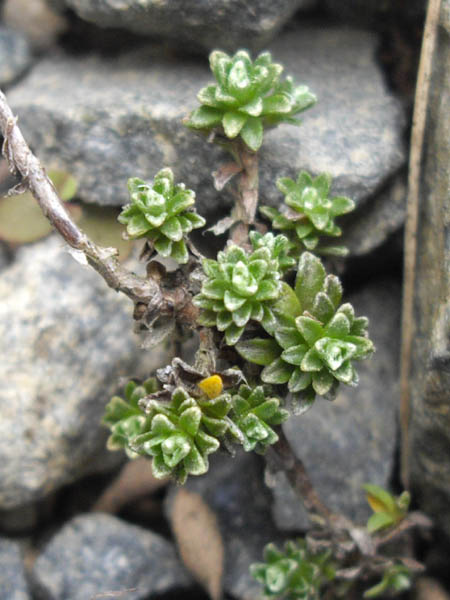
Mat-forming perennial of the Asteraceae family, endemic to New Zealand, present on both main islands, where it colonizes scree, gravel, and rocks of the alpine and subalpine levels.
It forms a dense and tight mat of small bright green rosettes, borne on woody stems clearly visible at the base, brown and branched, which structure the cushion and give it a characteristic appearance. The leaves, short and spatulate, are finely edged with silky hairs that give them a slight silvery sheen on the margins, hence the name subsericea. This detail, clearly visible under a magnifying glass, immediately distinguishes this species from Raoulia with uniformly gray or white foliage.
The capitula are solitary, white to cream, sometimes with a yellow disc, borne at the top of the stems and scattered over the entire mat in full bloom. In its natural habitat, its flowering extends from November to January. In European cultivation, it generally occurs in June-July.
As with the entire genus, drainage is the absolute condition for success. On a perfectly draining mineral substrate, Raoulia more easily withstand rainy winters.