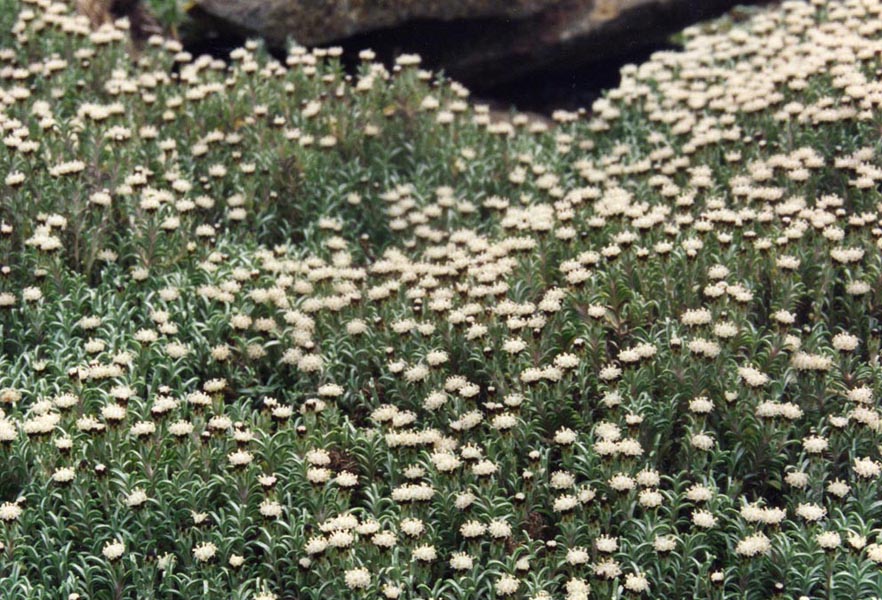
Mat-forming perennial of the Asteraceae family, endemic to New Zealand's South Island, where it grows on scree, gravel, and rocks in alpine and subalpine areas, often on schist or grauwacke substrates.
It is clearly distinguished from flattened rosette Raoulia by its dense, slightly domed cushion habit, formed by erect or ascending stems reaching 2 to 3 cm in height, giving it a noticeably taller silhouette than other mat-forming species of the genus. The leaves are linear-spatulate, narrow, arranged in tight whorls along the branches, dark green to gray-green, finely tomentose on the edges and underside. The woody stems at the base, clearly visible on older specimens, give it an architecture similar to some miniature alpine sub-shrubs.
The capitula, borne individually at the top of the stems, are white to cream, produced in very large numbers and literally covering the cushion in full bloom. In its natural habitat, it blooms from November to January. In European cultivation, it generally blooms in June-July.
It requires perfect drainage, full light exposure, and a well-draining mineral substrate.