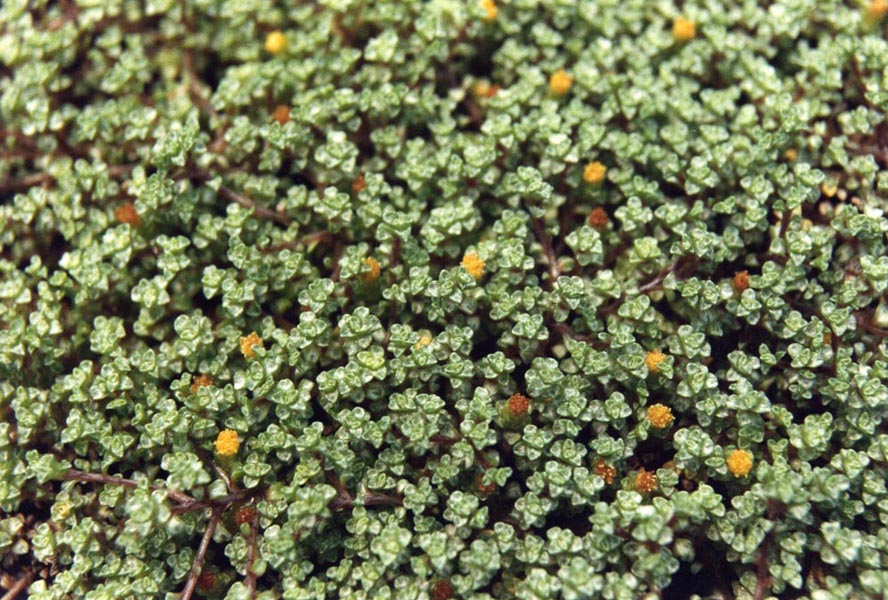
A mat-forming perennial of the Asteraceae family, endemic to New Zealand, where it occupies gravel, screes, and open rocky grounds in the alpine and subalpine zones of the two main islands.
It forms an extremely tight and flat mat, spreading across the ground in large patches that can cover several tens of centimeters. The rosettes are very small and very dense, with tiny leaves of medium green to gray-green, slightly silvered by a fine tomentum, giving the entire mat a pale gray-green hue, almost silvery from a distance. This foliage, much darker and greener than that of Raoulia australis, visually brings the plant closer to a dense moss or a crustose lichen plastered on the ground.
The flower heads, borne flush with the mat, are bright yellow to yellow-orange, small but clearly visible in contrast with the gray-green foliage. It is the only commonly cultivated mat-forming Raoulia to produce flowers of this color, which immediately distinguishes it from its close relatives. In its natural habitat, its flowering extends from November to January. In European cultivation, it generally occurs in June-July.
It requires perfect drainage, a poor mineral substrate, full light, and protection from stagnant winter moisture. Cultivation in a trough under glass shelter remains the most reliable solution in climates with wet winters.