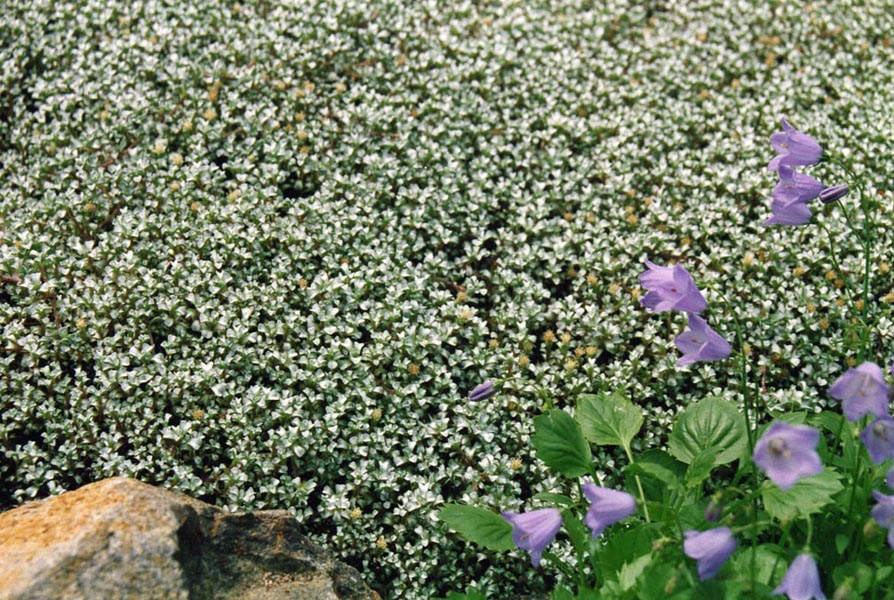
Mat-forming perennial of the Asteraceae family, endemic to New Zealand, where it occupies dry and open areas, riverbeds, and coastal dunes of the two main islands. The species is currently classified as "At Risk – Declining" by New Zealand authorities, threatened by the loss of its natural habitats due to plant invasions and agricultural development.
The stems, prostrate and very branched, root as they progress to form a dense mat, tightly pressed to the ground, which can exceed one meter in diameter. The leaves are tiny, less than 2 mm, spatula-shaped, very densely imbricated, covered with an applied tomentum that gives the mat its characteristic silvery hue, between gray and pale green depending on the light.
The capitula, 4 to 5 mm in diameter, bear bright yellow ligules. In its natural environment, its flowering extends from the end of the southern spring to the beginning of summer, from November to January.
The genus Raoulia honors Étienne Raoul, a French naval surgeon and naturalist, author of the Choix de plantes de la Nouvelle-Zélande published in 1846.
In cultivation, this species requires well-drained soil, preferably neutral to slightly acidic, although intolerance to limestone is not formally documented for this species. It finds its place in rock gardens, troughs, or between slabs, in a sunny exposure. Moisture stagnation, especially in winter, is fatal to it. Hardy to about –10°C in perfectly drained soil.