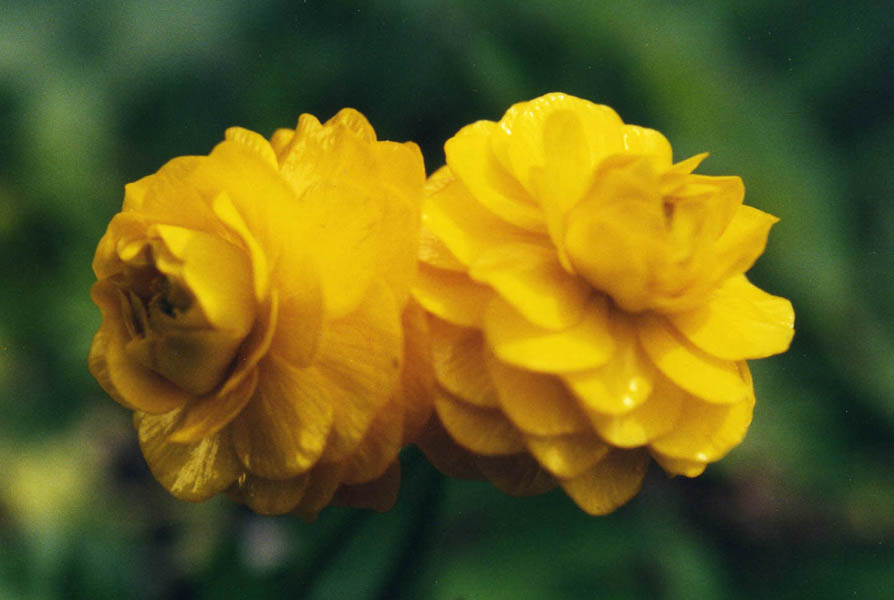
Horticultural form with double flowers of the meadow buttercup, a perennial of the Ranunculaceae family. The type species is widely spread in the moist meadows and lawns of Europe and temperate Asia; this cultivar is exclusively known in cultivation, where it has been established since at least the 16th century.
The plant forms upright clumps 40 to 60 cm in height. The leaves are palmate-lobed, deeply cut, medium green, borne on long petioles at the base and sessile towards the top of the branched stems.
The fully double flowers are composed of numerous imbricated petals of a bright, glossy golden yellow, giving each flower the appearance of a small, perfectly spherical pompom. The multiplication of petals, resulting from the transformation of stamens, eliminates all fertility, which explains why the plant does not reseed and reproduces only by division. In cultivation, flowering occurs from May to July.
Unlike the type species, whose sap is irritating and whose consumption by livestock is avoided, this sterile cultivar is of interest only for its ornamentation. The waxy and shiny texture of the petals, characteristic of the genus, is particularly accentuated here by the density of the double flower.
In cultivation, it accepts most ordinary soils, fresh to moderately moist, in sun or partial shade, and proves robust and undemanding once established.