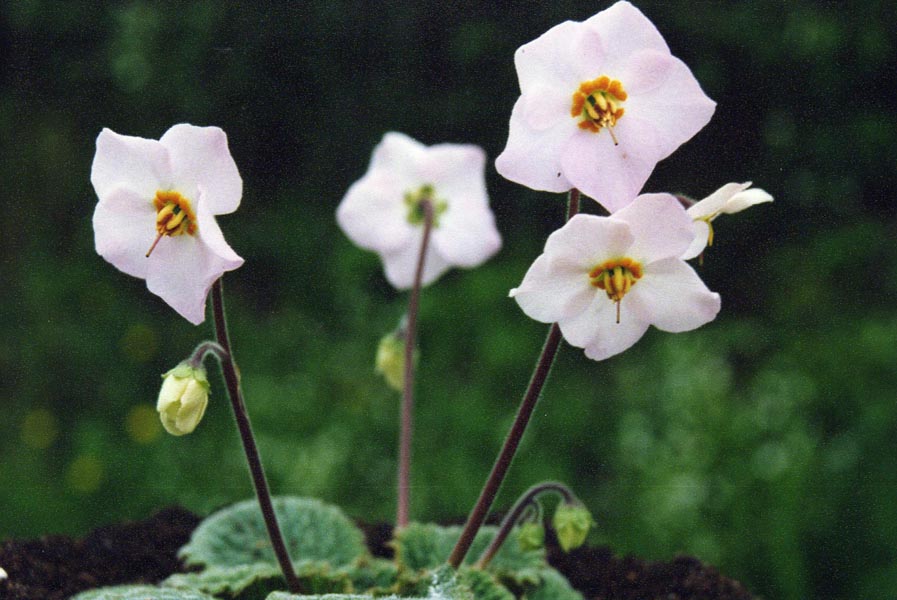
Light-flowered cultivar selected from the type species, this horticultural form of Ramonda myconi shares all the botanical characteristics of the wild Pyrenean plant, from which it differs only by the color of its flowers. It belongs to the family Gesneriaceae.
The rosette is identical to that of the type species, flattened, stemless, 5 to 10 cm in height, with wrinkled-blistered oval leaves, covered with dense, reddish-brown hair, with crenellated margins.
The slender, purple flower stalks bear widely spread corollas with four or five petals of a very pale pinkish white, almost pure white, contrasting with the bright yellow-orange cone of stamens that remains prominent and constitutes the focal point of each flower. This colorful detail at the heart of such a light flower produces a particularly delicate effect. In cultivation, flowering generally occurs in May-June.
The name 'Alba' is commonly used in horticulture to designate this pale-flowered form, although the petals are most often a white slightly tinged with pink rather than a pure bright white.
The growing conditions are identical to those of the type species: shaded to semi-shaded exposure, impeccable drainage, preferably planted in an inclined position in a rock crevice to avoid any water accumulation at the heart of the rosette.