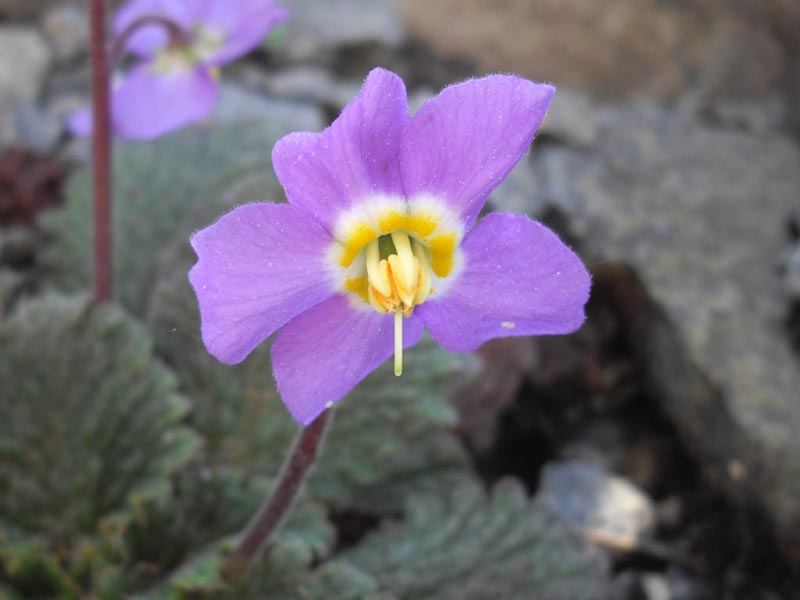
A perennial of the Gesneriaceae family, Ramonda myconi is an endemic species of the Pyrenees, present on both sides of the range, from Spanish Catalonia to the French Pyrenees-Atlantiques. It colonizes shaded rocky walls, crevices of limestone or siliceous rocks, and stabilized scree, between approximately 400 and 2,000 meters, almost always sheltered from direct sunlight.
It forms a flattened, stemless rosette, 5 to 10 cm in height, pressed against the rock. The leaves, oval to obovate, are thick, wrinkled-bullate, covered with dense, reddish hairiness that gives them a very characteristic velvety texture; their margins are crenellated.
The flowers, borne on slender, purple stalks of 8 to 15 cm, bloom in spread corollas with four or five bright violet-lilac petals, with a bright yellow ring encircling a cone of orange stamens at the center. In its natural habitat, its flowering extends from May to July depending on the altitude. In cultivation, it generally blooms in May-June.
This plant possesses a remarkable ability for reviviscence: its rosettes can completely dry out during drought periods and then resume normal activity after rehydration, a rare adaptation among vascular plants.
In cultivation, it requires a shaded to semi-shaded exposure, excellent drainage, and preferably planting in an inclined or vertical position in a rock crevice, to prevent water stagnation at the heart of the rosette. It tolerates limestone well.