Perennial of the Ranunculaceae family, present in Western and Central Europe, from England to Denmark and Central Europe. It occupies dry and open calcareous grasslands, sunny slopes, and lean meadows on chalk or limestone, at low and medium altitude.
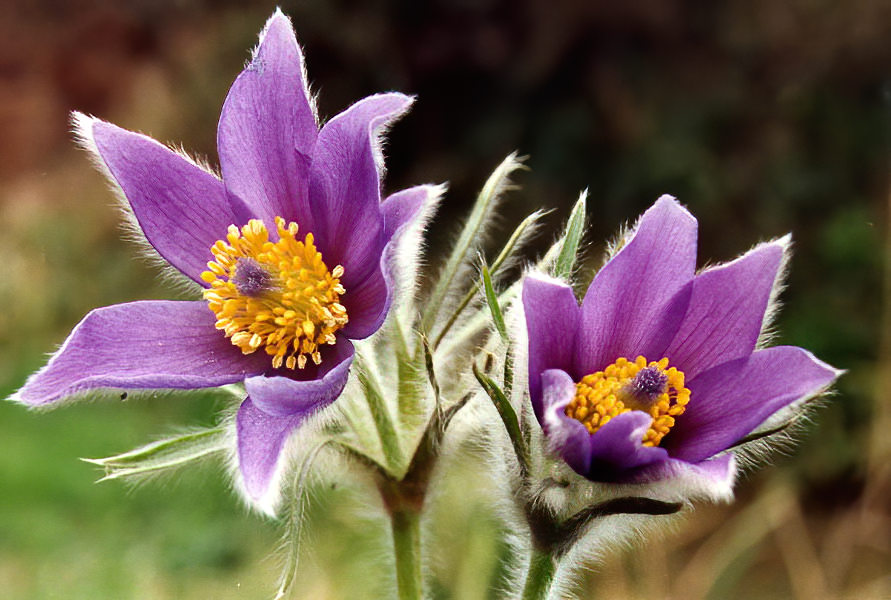
It forms clumps of 15 to 30 cm at flowering, with finely cut foliage into narrow and numerous segments fully developing after the flowers. The stems and bracts are covered with a silky silver-white pubescence, particularly visible on the still inclined buds.
The flowers, with six spread to slightly curved tepals, present a range of colors from pale lilac to dark purple depending on the individuals. The center, formed of a dense cluster of golden yellow stamens, contrasts sharply with the tepals. It is the species of the genus that presents the greatest natural variability of hue, ranging from almost white to dark purple, which explains the abundance of selected cultivars. In its natural habitat, its flowering extends from March to May. In cultivation, it generally blooms from March to April.
It requires well-drained soil, preferably calcareous, in full exposure.