A perennial of the Boraginaceae family, this lungwort belongs to a taxonomic complex whose boundaries between Pulmonaria officinalis sensu stricto, P. affinis, and P. saccharata remain debated according to reference floras. The plant presented here was collected in the Landes, where it grows in cool woodlands, on humus-rich soils, in shade or partial shade.
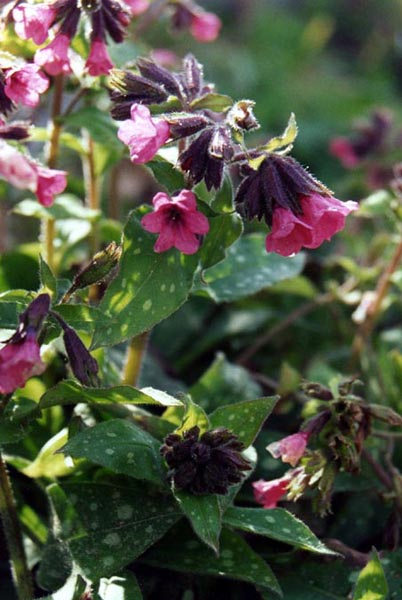
The foliage is oval to elliptical, medium green, marked with irregular white-silver spots characteristic of the group. The calyxes are remarkably dark, almost black at maturity.
The flowers are a deep pink and do not turn blue-violet, contrary to the usual behavior of lungworts, where this color change is linked to a variation in cellular pH during flowering. This total absence of color change, stable across all individuals of this form, is the most singular feature of this plant. In its original population, it coexists with individuals with blue-violet flowers, with the two forms being more or less geographically concentrated.
In its natural habitat, its flowering extends from February to April. In cultivation, it requires a cool, humus-rich, well-drained soil, in shade or partial shade, without prolonged summer drought.