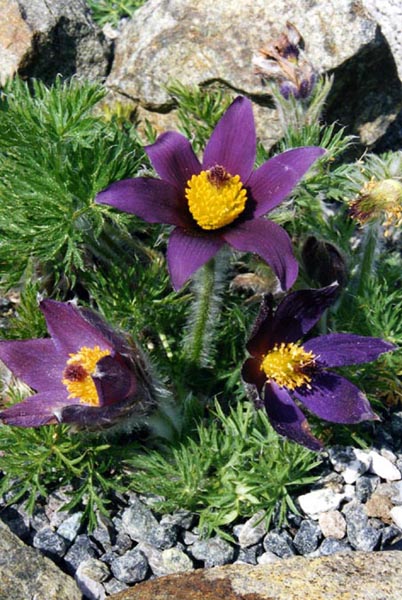
Perennial from the Ranunculaceae family, present in the southwestern Alps, the Maritime Alps, the northern Apennines, and some Balkan massifs. It occupies open rocky grasslands, stabilized scree, and sunny calcareous slopes, generally between 1,500 and 2,500 meters in altitude.
It forms small compact clumps, reaching 10 to 20 cm in height at flowering. The foliage is very finely cut, pinnatisect with narrow segments, a bright green, densely hairy on the stems and bracts, this silvery and silky pubescence being one of the most immediately striking features of the plant, visible even on still closed buds.
The flowers are solitary, erect to slightly spreading, with six tepals of a deep purple violet, almost dark, sharply contrasting with the very dense orange-yellow center of stamens. The outer surface of the tepals is covered with long silvery silky hairs that shimmer in full sun. In its natural habitat, its flowering extends from April to June depending on altitude. In cultivation, it generally blooms in April-May.
It requires well-drained soil, preferably calcareous, poor to moderately rich, in full sun.