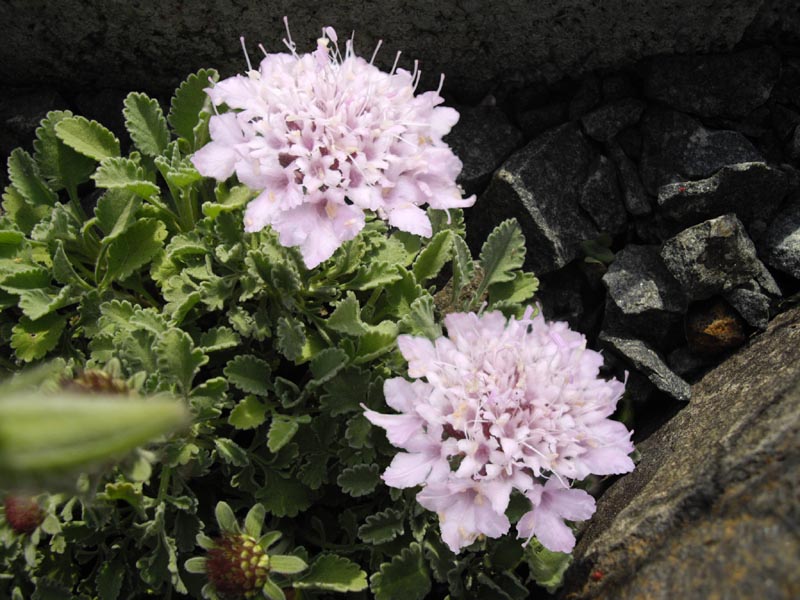
Perennial of the Caprifoliaceae family (formerly Dipsacaceae), endemic to Greece, mainly known from the limestone massifs of Parnassus and a few other peaks in the center and north of the country. It occupies rocky areas, cliff fissures, and stabilized scree, generally between 1,500 and 2,400 meters in altitude.
It forms low, spreading clumps, 8 to 15 cm in height, with woody stems at the base and evergreen foliage. The leaves are small, crenate to lobed, grayish-green, covered with a fine down that gives them a soft, matte texture, clearly visible on the margins.
The flower heads, noticeably larger than those of P. depressus, are borne on short, erect peduncles. They gather pale lilac pink to whitish pink flowers, the peripheral flowers enlarged and irregularly lobed in the manner of a scabious, framing a dense center of dark purplish-brown, streaked with dark veins, which strongly contrasts with the light periphery. This dark heart is one of the most immediately striking features of the species. In its natural habitat, its flowering extends from June to August.
In cultivation, it requires full sun, impeccable drainage, and poor calcareous soil. It is suitable for rock gardens, alpine troughs, and wall fissures exposed to the south, sheltered from excessive winter moisture.