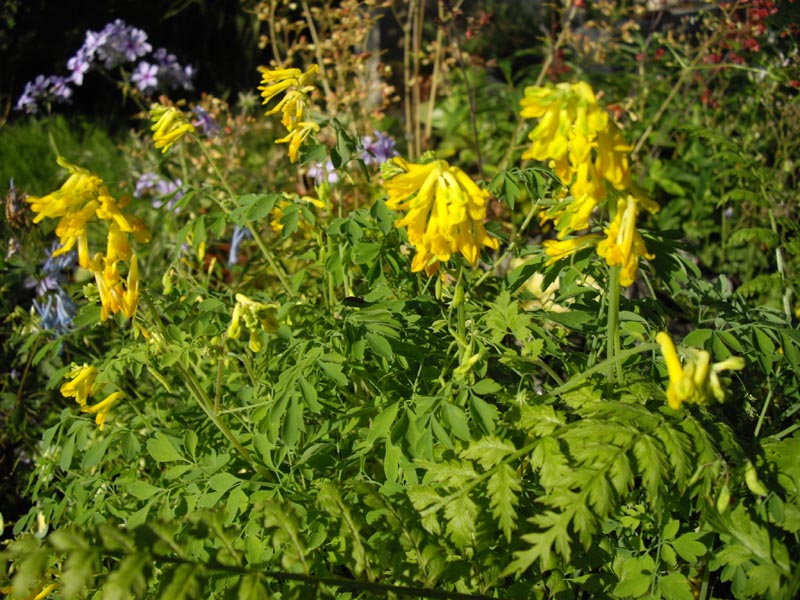
syn. Corydalis lutea
syn. Corydalis lutea
Perennial of the Papaveraceae family, native to the southern Alps, the southern slopes of the Italian Alps and the limestone foothills of northern Italy. It has become widely naturalized in Western Europe, colonizing old walls, shaded screes, rock crevices, and the bases of embankments, generally on limestone substrate, from the plains up to about 1,500 meters.
It forms flexible and dense bushy clumps, 20 to 35 cm in height, with fragile stems branching from the base. The foliage is fine, very divided, bipinnatifid, of a medium green slightly glaucous, with an airy appearance reminiscent of delicate ferns or certain Fumaria.
The tubular flowers, bright yellow to lemon yellow, are gathered in upright then drooping clusters, borne well above the foliage. The well-marked spur at the base of each flower is a constant feature of the genus. In its natural habitat, its flowering extends from April to September. In cultivation, in a cool and shaded site, it blooms almost continuously from spring to the first frosts.
It reseeds abundantly and naturally colonizes wall crevices and paving joints in shade or partial shade. It prefers well-drained, cool, limestone soils. Its longevity in the same spot is variable; spontaneous seeding ensures its maintenance in suitable gardens.