syn. Veronica longifolia
syn. Veronica longifolia
Perennial of the Plantaginaceae family, widely spread in Central and Northern Europe, from Scandinavia to the Pontic regions, and in temperate Asia. It naturally grows in wet meadows, riverbanks, tall herb communities, and fresh forest edges, generally in plains or low mountains.
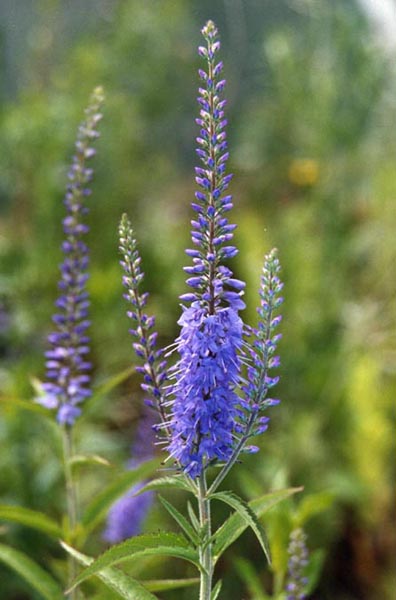
It forms upright and vigorous clumps, reaching 60 to 100 cm in height. The leaves are lanceolate, elongated, with distinctly toothed margins, arranged in whorls of three or in opposite pairs along the stems, a bright and fairly glossy green.
The flowers, small corollas with four fused petals, are gathered in long, narrow, and very dense terminal spikes, of a characteristic blue-violet to lavender blue, opening progressively from the base to the top. These slender spikes, which can exceed 20 cm in length, are the main ornament of the plant. In its natural habitat, its flowering extends from July to August. In cultivation, it occurs at roughly the same dates.
It is cultivated in full sun to partial shade, in fresh to moist soil, rich in humus, without prolonged summer drought. It is suitable for large perennial beds, near water features, and naturalistic gardens. Dividing the clumps in spring every three or four years maintains its vigor.