syn. Centaurea dealbata
syn. Centaurea dealbata
Perennial of the Asteraceae family, native to the Caucasus and adjacent regions of eastern Anatolia. It naturally grows in mountain meadows, the edges of light forests, and grassy slopes, on well-drained soils.
It forms upright clumps 40 to 60 cm tall, with deeply cut, pinnatifid foliage, medium green on the upper surface and distinctly whitish-tomentose underneath, which earned it the epithet dealbatus, whitened. This is one of its most constant and easily verifiable distinguishing features.
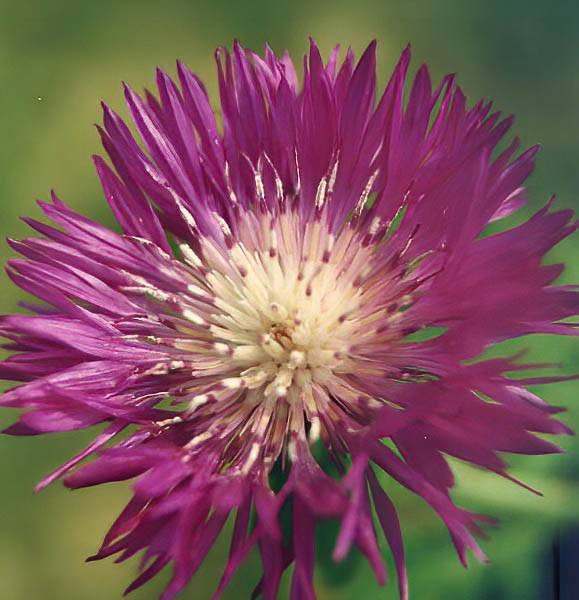
The solitary flower heads at the top of the stems present a striking bicolor: the peripheral ligulate flowers are a bright pink-purple to magenta, while the center forms a creamy to whitish disc, an immediately striking contrast. In its natural habitat, it blooms from June to July. In cultivation, it can partially rebloom in summer if the faded flower heads are removed.
It is cultivated in full sun, in ordinary well-drained, rather poor soil; overly rich soil favors foliage at the expense of flowering. Hardy and undemanding, it is easily divided in spring to rejuvenate clumps that tend to thin out in the center after a few years.