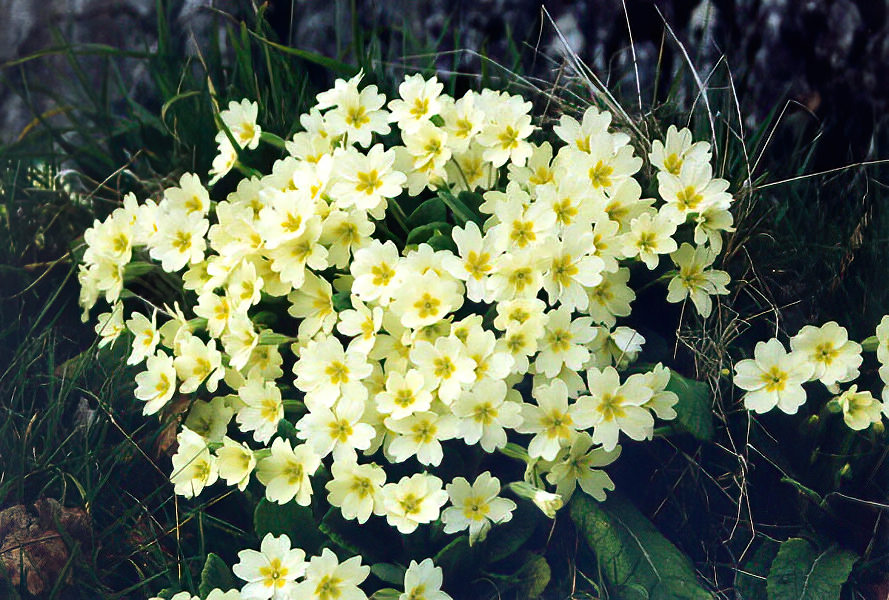
A perennial of the Primulaceae family, the primrose is one of the most widespread and familiar species of Western Europe, present from Great Britain and Ireland to the Mediterranean basin and Asia Minor. It colonizes the edges of woods, hedges, shaded banks, fresh meadows, and light undergrowth, from the plains up to the lower montane level.
It forms a low and spreading rosette of oval to oblong leaves, strongly wrinkled and crinkled, of a bright green, softly hairy on both sides. Unlike the cowslip, its flowers are borne individually on short peduncles arising directly from the rosette, without a common stem, giving it a particularly low and bushy habit. The flowers are pale sulfur yellow, with a brighter yellow throat, with five deeply notched petals.
In its natural habitat, its flowering extends from February to April depending on exposure and region. In cultivation, it can bloom as early as January during mild winters.
It appreciates a fresh, humus-rich, well-drained soil, in partial shade or under light cover. It readily self-seeds and forms excellent dense clumps over the years. Many cultivars with varied colors have been derived from it, but the wild sulfur yellow form remains the most sober and natural.