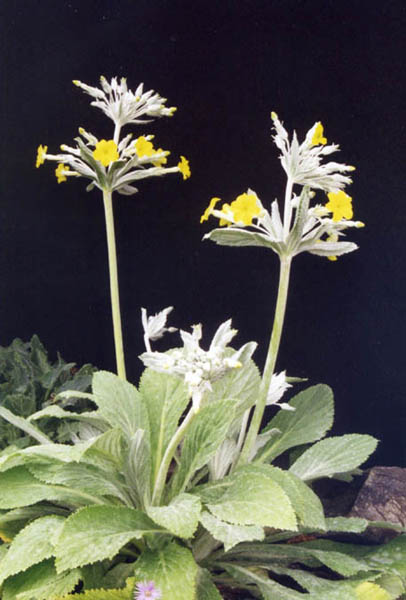
syn. Primula verticillata
syn. Primula verticillata
Perennial of the Primulaceae family, this species is native to the Arabian Peninsula and northeastern Africa, notably Yemen and Saudi Arabia, where it grows in rocky crevices and shaded cliffs of mountainous regions, at altitudes exceeding 2,000 meters. It belongs to the Floribundae section of the Primula genus, sometimes now separated under the genus Evotrochis.
The plant forms a broad rosette of oval leaves with crenate edges, remarkably covered with a silvery white farinose indumentum that gives the whole a very characteristic frosted appearance. The upright flower stalks, 20 to 35 cm tall, bear superimposed whorls of bright yellow flowers with an orange throat, tubular and slightly drooping, arranged in successive tiers, an immediately recognizable distinctive feature.
In its natural habitat, its flowering extends from February to April depending on altitude. In cultivation under a cold frame or in a temperate greenhouse, it blooms in winter to early spring.
It requires perfect drainage and serious winter protection. Its Arabian origin, in mountainous regions with dry winters, makes it sensitive to frost. Pot culture, brought indoors away from frost as soon as autumn arrives, remains the most reliable solution.