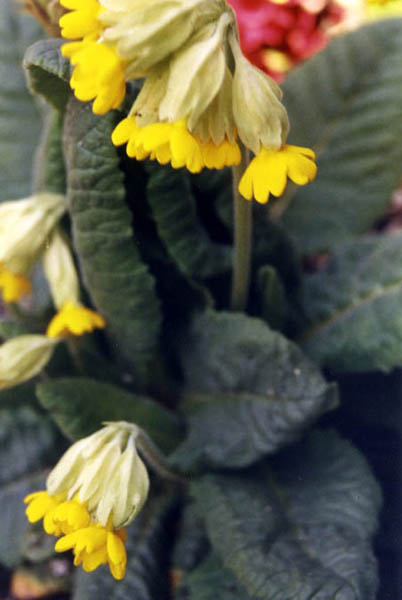
Perennial of the Primulaceae family, this subspecies is distinguished from the typical form by an eastern distribution area, covering the Caucasus, Central Asia, Turkey, and Iran. It occupies open meadows, steppe grasslands, and grassy slopes, often on calcareous or clay-limestone substrates.
The general habit is similar to that of Primula veris, with a rosette of oval to oblong leaves, heavily wrinkled and hairy, with a marked dark green, slightly blistered surface. The most distinctive feature of this subspecies lies in its calyx, notably larger and more swollen than that of the typical subspecies, with broader and more developed teeth, which gives it its epithet macrocalyx. The flowers are bright yellow, tubular, borne in drooping umbels on stems 15 to 25 cm tall.
In its natural habitat, its flowering extends from April to May depending on altitude and latitude.
In cultivation, it behaves similarly to the common cowslip, appreciating well-drained soil, ordinary to slightly calcareous, in full sun or partial shade. It is hardy and propagates by seed.