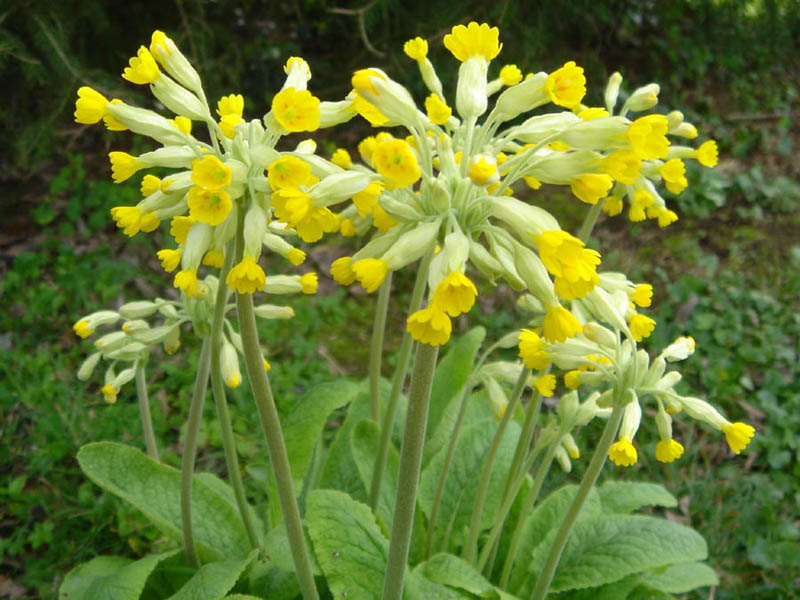
Perennial of the Primulaceae family, widely spread throughout Europe and a large part of temperate Asia. In France, it is present in almost all regions, from the plains to the lower mountain levels. It colonizes dry to mesophilic meadows, calcareous lawns, edges of light woods, embankments, and sunny grassy slopes.
It forms a rosette of oval to oblong, wrinkled, softly hairy leaves of medium green, with a winged petiole; the foliage, slightly rough to the touch, is one of the most constant elements for species identification. The upright flower stems reach 15 to 20 cm and bear a nodding umbel of bright yellow tubular flowers, with a throat marked by orange spots, slightly inclined downwards, giving them a characteristically drooping appearance.
In its natural habitat, its flowering extends from April to May. In cultivation, it blooms from the end of March depending on conditions.
The cowslip, as it is commonly called, is a melliferous plant appreciated by bumblebees in early spring. Its flowers have been used in traditional medicine and infusions; their harvest in the wild is now discouraged due to the decline of wild populations.
It adapts to ordinary, well-drained soil, preferably calcareous, in full sun or light partial shade. It is robust, easy to propagate by seed, and readily reseeds itself in the garden.