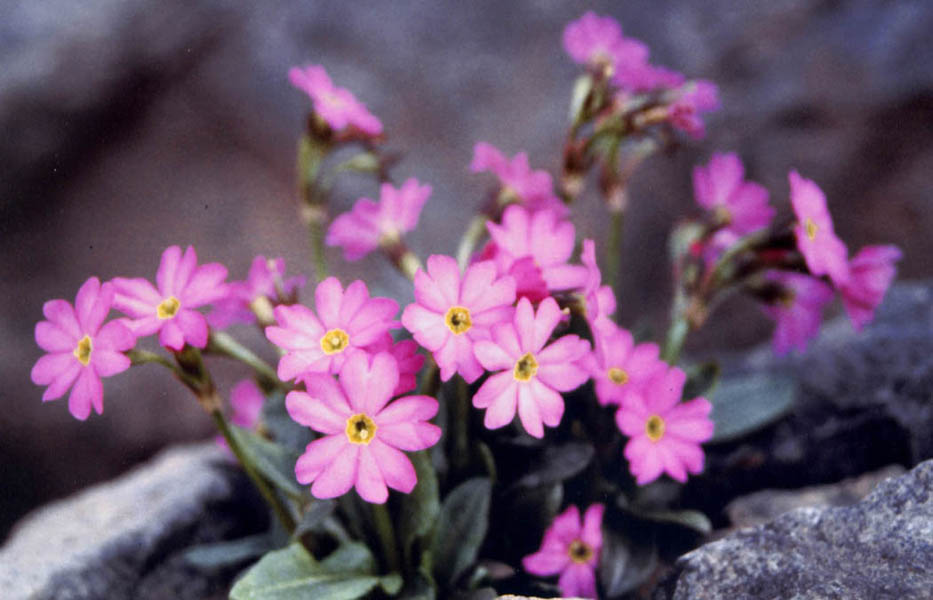
Perennial of the Primulaceae family, belonging to the Oreophlomis section, native to the western Himalayas, from Pakistan to Kashmir and northwestern India, where it grows in moist alpine meadows, stream banks, and snowmelt areas, at altitudes of approximately 2,500 to 4,500 meters.
It forms small compact clumps barely exceeding 10 to 15 cm in bloom. Its leaves, still very reduced at the time of flowering, are oblong to spatulate, slightly toothed, of a medium green to reddish bronze in the young stages — they lengthen significantly after flowering to reach their full development in summer.
This phenological peculiarity is one of the most remarkable of the species: the flowers precede the complete foliar development by a wide margin, emerging almost from the bare ground at the edge of meltwaters, which gives them a presence of great visual intensity. The flowers are bright pink to pure magenta pink, with a well-defined yellow eye, grouped in umbels carried on short peduncles.
In its natural habitat, its flowering extends from April to June depending on the altitude. In cultivation, it blooms from March-April, being among the first primroses of the season.
It requires constantly moist soil, even waterlogged during the growing season, rich in humus, in a cool exposure. It is suitable for the banks of water bodies and moist rock gardens, provided that summer drought is rigorously avoided.