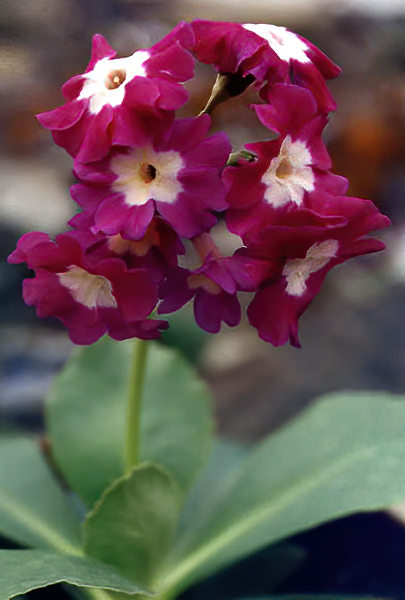
Perennial of the Primulaceae family, Primula pedemontana is an endemic species of the southwestern Alps, mainly the Piedmont, Ligurian Alps, and some stations in Savoy. It grows in rock crevices and siliceous scree, on gneiss or schist, between approximately 1,800 and 2,800 meters.
The plant forms low and compact rosettes from 4 to 15 cm in height when in bloom. The leaves are obovate to oblong, light green, weakly toothed, finely pubescent, and bordered with well-visible red pedicellate glands, a distinctive feature useful for identification in the field.
The flowers, grouped in umbels of 1 to 12, are bright purple-violet to magenta, with notched lobes and a well-developed tube. In its natural habitat, its flowering extends from June to July depending on the altitude. In cultivation, it generally blooms in April-May.
The plant cultivated in this collection, with dark purple-red flowers with a strongly contrasting white eye, presents characteristics that somewhat deviate from the typical wild form. It could be a hybrid or a horticultural selection.
In cultivation, it requires an acidic, very well-drained substrate, rich in gravel, with partial shade exposure, protected from excessive winter moisture. Cultivation in an alpine trough or rock garden crevice suits it perfectly.