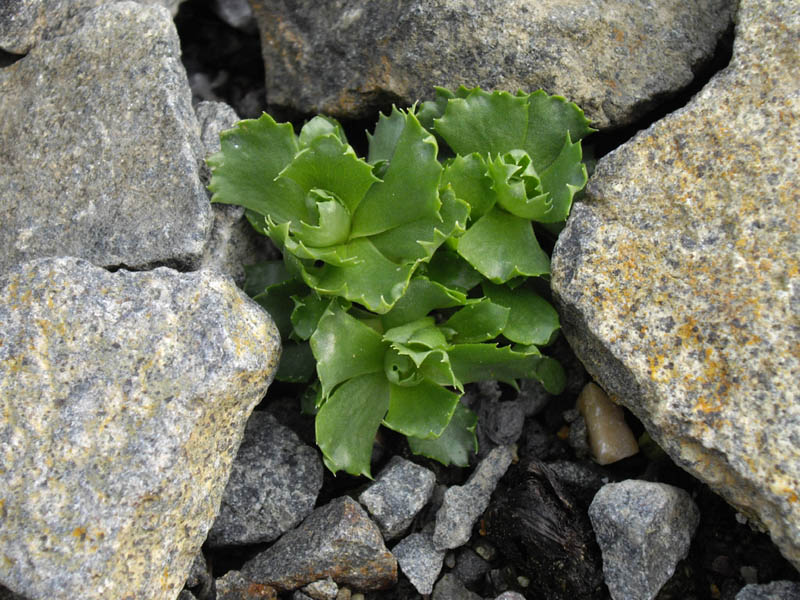
Perennial of the Primulaceae family, Primula minima is a species of the mountains of Central and Eastern Europe, present in the Eastern Alps, the Carpathians, the Northern Apennines, and the Balkans. It colonizes acidophilic alpine meadows, crevices of siliceous rocks, and snow hollows, between approximately 1,600 and 2,800 meters of altitude, on acidic to neutral substrates.
Despite its epithet, it does not go unnoticed thanks to its bright and glossy green foliage, very distinctive. The leaves are wedge-shaped or truncated spatula-shaped, widened at the top with a deeply saw-toothed apical margin, almost lacerated, giving them an immediately recognizable appearance among all alpine primroses. They are organized in dense and flattened rosettes, clinging to the rock or ground, barely exceeding 1 to 4 cm.
The flowers, in bright pink to intense carmine pink, are solitary or very rarely in pairs, borne on very small barely emerging stems, with very deeply notched petals giving the impression of eight-petaled flowers. In its natural habitat, its flowering extends from June to August depending on the altitude, often immediately after the snow melts.
In cultivation, it imperatively requires an acidic, very well-drained substrate, based on granite or pozzolana, without limestone. It is more accommodating in an alpine trough than in open ground, where winter stagnation is fatal to it.