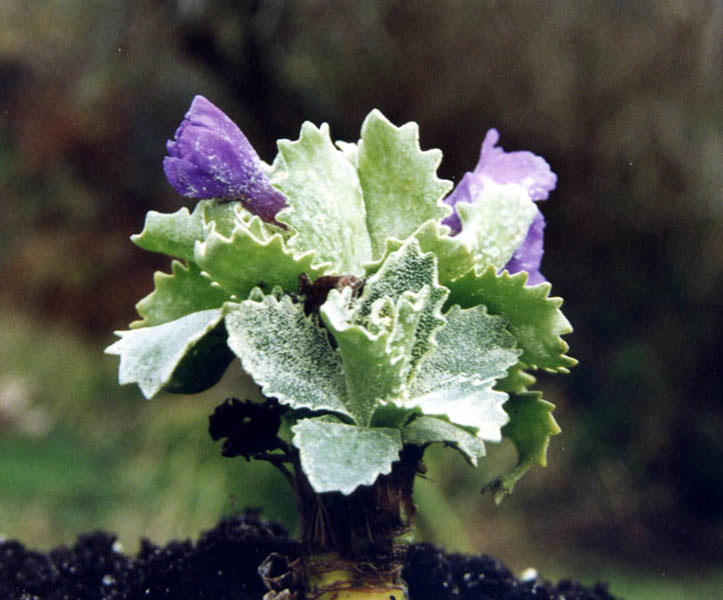
Perennial of the Primulaceae family, Primula marginata is a species from the Franco-Italian Maritime Alps, where it colonizes limestone cliffs, rocky ledges, and rock crevices, generally between 1,000 and 2,500 meters in altitude. The form or selection 'Caerulea' is distinguished by the particularly blue hue of its flowers, rare in the genus.
The plant forms a compact rosette borne by a well-visible woody stipe, characteristic of the genus in its long-cultivated forms. The leaves, spatulate to slightly toothed, are covered with a white flour — the farinose — which gives them a very recognizable grayish to glaucous appearance, with a clear white edge on the margins, a trait that gave the species its name.
The flowers, of a fairly strong bluish lilac, with a pale throat, are grouped in a short and tight umbel in spring. In its natural environment, its flowering extends from April to June depending on the altitude; in cultivation under cold shelter or in rock gardens, it often occurs as early as March.
It requires well-drained, slightly alkaline soil, a semi-shaded exposure with protection against excessive winter rains. It is successfully cultivated in a pot in a mixture based on coarse limestone, in a cold greenhouse or in a trough.