Perennial of the Primulaceae family, belonging to the Cortusoides section, native to central and western China, mainly Sichuan and Yunnan, where it grows in shaded undergrowth, humid wooded slopes, and rocky gorges, at altitudes between approximately 2,000 and 3,500 meters.
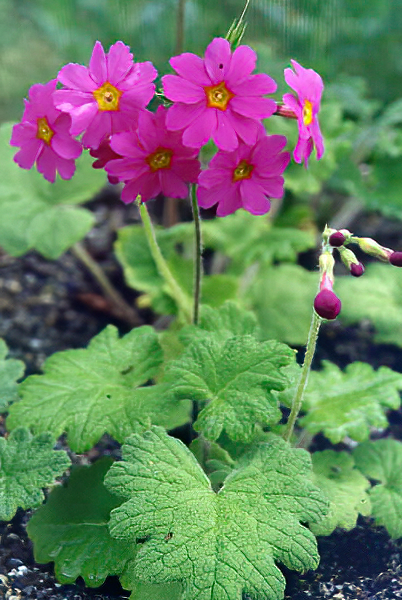
Its foliage is one of its most distinctive features in the section: the leaves are long-petioled, reniform to cordiform, deeply lobed and crenate, bright green and distinctly wrinkled, indeed reminiscent of Heuchera leaves — which its epithet explicitly recalls. The leaf surface, rough and slightly pubescent, captures light in a very particular way under cover. The plant forms a supple and spreading rosette, reaching 20 to 35 cm in height in bloom.
The slender, upright stems bear umbels of flattened flowers, a bright rose-magenta to intense rose-violet, with a well-defined orange eye that warms the whole. The petals are slightly notched at the top.
In its natural habitat, its flowering extends from April to June depending on exposure and altitude. In cultivation, it generally blooms in April-May.
It requires cool, humus-rich, well-drained soil, in shade or partial shade, sheltered from direct sunlight and drought. It is suitable for woodland gardens and shaded compositions, where its textured foliage remains decorative well after flowering.