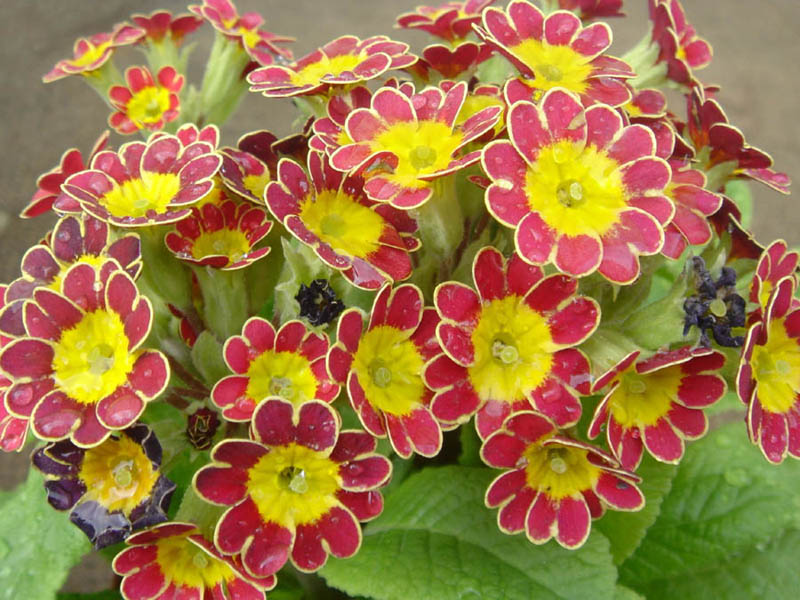
The polyanthus primroses are hybrids resulting from crosses between Primula vulgaris and Primula veris, selected and cultivated in Europe for several centuries. 'Gold Lace' belongs to an ancient tradition of British selection, the "Gold-laced Polyanthus," whose origins date back to the 18th century in the workers' gardens of northern England. These plants were then presented at highly codified flower shows, where the regularity of the edging and the clarity of the contrast were judged with great rigor. This competitive flower past makes it one of the best-documented horticultural pedigree primroses.
The plant forms a rosette of oval, medium to bright green, crinkled leaves, reaching 15 to 20 cm in height in bloom. The flowers are borne in umbels on upright stems; their distinctive character is absolute: each petal, from crimson red to very dark burgundy, is edged with a fine golden to cream border of remarkable precision, framing a bright yellow eye. Selections vary from almost black dark red to bright red, but the principle of the contrasting border remains constant.
In cultivation, flowering extends from April to May. The plant prefers cool, humus-rich soil in partial shade; it does not tolerate summer drought. Propagation by division is recommended to preserve the cultivar's characteristics, as sowing produces variable results.