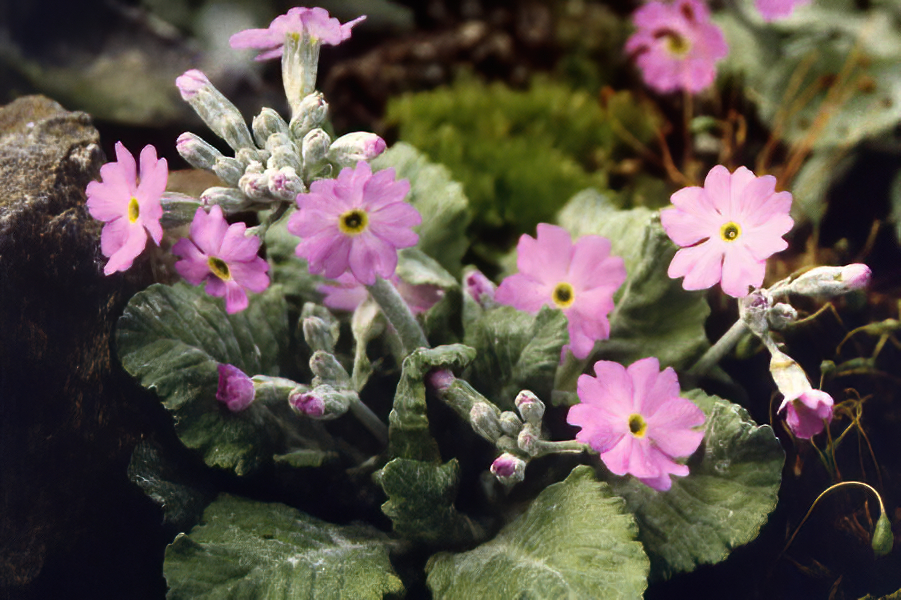
A perennial of the Primulaceae family, Primula frondosa is an endemic species of the Balkans, native to Bulgaria and northern Greece, where it grows in crevices of limestone rocks and moist rocky slopes, generally between 1,000 and 2,000 meters in altitude.
It forms low and dense rosettes from 3 to 15 cm in height when in bloom. The leaves are oval to spatulate, medium green, slightly rough and covered with a white floury coating visible on both sides, giving them a characteristic grayish appearance, particularly striking on the densely floury stems and calyxes. This feature easily distinguishes it from Primula farinosa, to which it is often compared.
The flowers, gathered in fairly abundant umbels, are a lilac pink to fairly deep pink-violet, with slightly notched lobes and a well-defined yellow eye. The photos clearly show the density of the umbels and the generosity of the flowering, as well as the contrast between the silvery floury stems and the colorful corollas. In its natural habitat, its flowering extends from April to June. In cultivation, it blooms from March-April.
In cultivation, it proves to be much more accommodating than many other rock garden primroses. It accepts a well-drained calcareous substrate, fresh without being waterlogged, in a semi-shaded exposure. Accessible to sowing and relatively hardy, it constitutes a good introduction to the primroses of the Farinosae section.