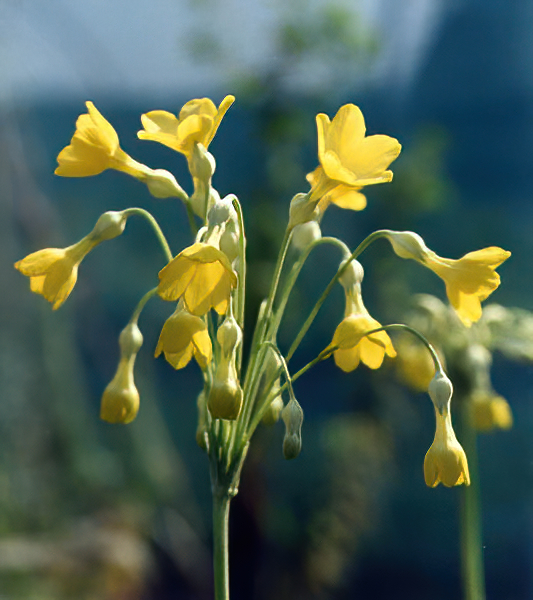
Perennial of the Primulaceae family, belonging to the Sikkimensis section, native to southeastern Tibet, where it grows by streams, marshes, and waterlogged meadows at altitude, generally between 3,500 and 4,500 meters. It was discovered and introduced into cultivation by the botanist-explorer Frank Kingdon-Ward in 1924, who named it after his first wife, Florinda.
It is one of the largest primroses of the genus in temperate cultivation. The rosettes produce large heart-shaped leaves, long-petioled, bright green, with a crenate margin, which can exceed 20 cm. The robust, erect, and farinose stems commonly reach 60 to 90 cm in favorable moist conditions. They bear a drooping umbel of numerous tubular flowers, in bell-shaped blooms inclined downwards, of a bright sulfur-yellow, covered with a slight whitish farinose that gives them a characteristic powdered appearance. A sweet and musky fragrance emanates from the flowers in full bloom.
In its natural habitat, its flowering extends from June to August. In cultivation, it blooms from June to July, among the latest primroses of the season.
It requires constantly moist to waterlogged soil, rich in organic matter, in full sun or light partial shade. It thrives on the edge of a water feature or stream, in bog gardens, where it can form over time vast and very spectacular colonies.