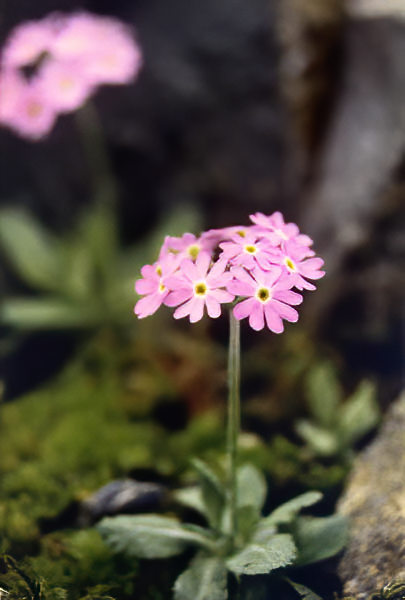
Perennial of the Primulaceae family, Primula farinosa is widespread across a large part of temperate and boreal Eurasia, from the Pyrenees and the Alps to Scandinavia, Siberia, and Central Asia. It frequents peat meadows, calcareous seepages, spring edges, and high-altitude moist lawns, generally between 1,000 and 2,500 meters in the alpine massifs, but descends much lower in the north of its range.
The plant forms small low rosettes 5 to 15 cm in height when in bloom. The leaves are oblong to spatulate, medium green on the upper side, and covered with a white to yellowish flour on the underside, a characteristic that gave the species its name and is immediately visible in the field. The flower stalk is also slightly floury.
The flowers, gathered in umbels of 5 to 15, are a bright lilac-pink to pink-violet, with notched lobes and a well-marked yellow eye. The photos clearly show this bright and vivid color, as well as the slenderness of the stalks. In its natural habitat, its flowering extends from May to July depending on altitude. In cultivation, it blooms in April-May.
In cultivation, it requires fresh to moist, calcareous, well-aerated soil, in full light or light partial shade.