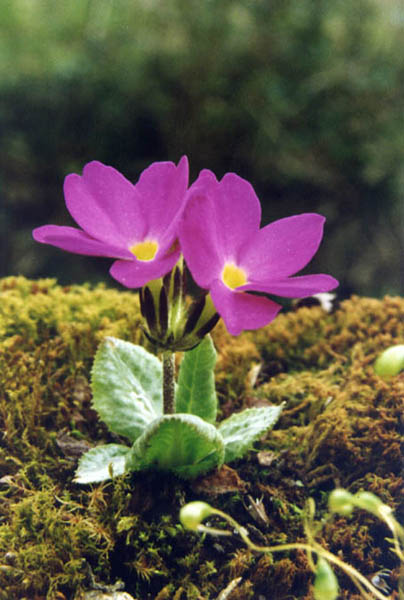
Perennial of the Primulaceae family, belonging to the Denticulata section, native to the Himalayas, from Afghanistan to the southwest of China, where it colonizes humid alpine meadows, stream banks, and grassy slopes, between approximately 2,500 and 4,500 meters.
It forms large rosettes of oblong to spatulate leaves, distinctly toothed on the margins — a characteristic to which it owes its epithet — of medium green, slightly farinose on the underside in some individuals. One of its most striking traits is its ability to bloom while the leaves are still tiny, reduced to a small rosette of just a few centimeters: the scape emerges from the ground and the capitulum blooms well before the foliage has reached its full development. The leaves will continue to elongate after flowering, then reaching 25 to 30 cm.
The robust and upright scapes bear a dense and tight globular capitulum, immediately recognizable in the genus. The flowers range from pale lilac to purple-violet, bright pink, and white depending on the individuals and horticultural selections, always with a well-defined yellow central eye. Double-flowered forms exist in cultivation.
In its natural habitat, its flowering extends from March to May depending on the altitude. In cultivation, it blooms from February to April, being among the first perennials to open in the season.
Hardy and accommodating, it is cultivated in fresh to moist soil, rich in humus, in sun or partial shade, without prolonged summer drought. It is suitable for flower beds, banks, and natural gardens in a temperate climate.