Perennial of the Primulaceae family, belonging to the Cortusoides section, native to western and central Siberia, from the Ural Mountains to eastern Siberia and Japan. It grows in clear undergrowth, forest edges, and shaded rocky slopes, both in lowlands and at moderate altitudes.
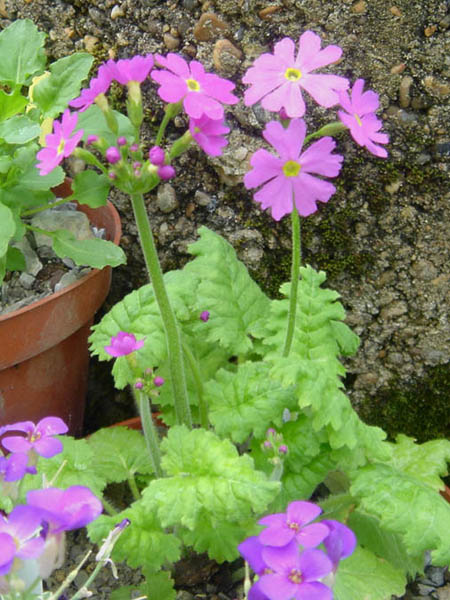
It forms rosettes of long-petioled leaves, heart-shaped to kidney-shaped, deeply lobed and irregularly toothed, of a bright and fresh green, softly pubescent, with a supple texture. This dissected foliage, reminiscent of that of Cortusa from which it derives its epithet, is one of its most distinctive features within the genus. The plant goes into complete dormancy in summer after flowering, disappearing entirely from the ground.
The floral stems, slender and upright, reach 20 to 25 cm and bear an umbel of pink-lilac to pink-magenta flowers, with five notched petals and a well-visible yellow eye. The flowers, slightly nodding at anthesis, are arranged in an airy bouquet at the top of the stem.
In its natural habitat, its flowering extends from April to June. In cultivation, it generally blooms in April-May.
It is cultivated in cool, humus-rich, and well-drained soil, in the shade or partial shade, sheltered from summer heat. Its summer dormancy must be respected by avoiding any excess moisture once the foliage has disappeared. It is suitable for woodland gardens, shaded rockeries, and container cultivation.