Perennial of the Primulaceae family, belonging to the Proliferae section of candelabra primroses, native to Burma and Yunnan, where it inhabits wet meadows and the banks of high-altitude streams, between approximately 2,000 and 3,000 meters.
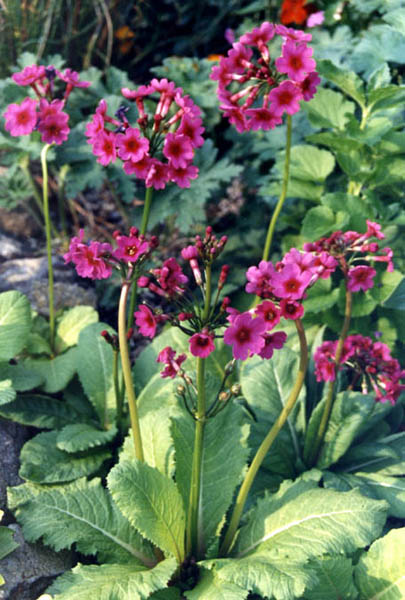
It develops large rosettes of oval to oblong leaves, distinctly crinkled and veined, in a fairly bright vivid green, with irregularly toothed margins. The flower stalks, slender and non-mealy, reach 30 to 50 cm and bear several superimposed whorls of flowers. The flowers are a deep magenta-pink to true purplish-pink, with a well-contrasted yellow eye, which clearly distinguishes them within the candelabra group. The buds and calyxes are a dark red. The overall hue is one of the brightest and most saturated among the primroses of this section.
In its natural habitat, its flowering extends from June to July depending on the altitude. In cultivation, it blooms in May-June.
It requires a rich, moist, and permanently cool soil, in a sunny to slightly semi-shaded position. Like other candelabras, it easily hybridizes with neighboring species cultivated nearby, and self-seeds spontaneously in suitable conditions. It is suitable for banks, damp woodland gardens, and natural compositions in cool climates.