Perennial of the Primulaceae family, this candelabra primrose is native to Yunnan, in southwest China, where it was first collected by George Forrest in the early 20th century. It grows in wet meadows and stream banks at altitude, between approximately 2,500 and 3,500 meters, within the Proliferae section.
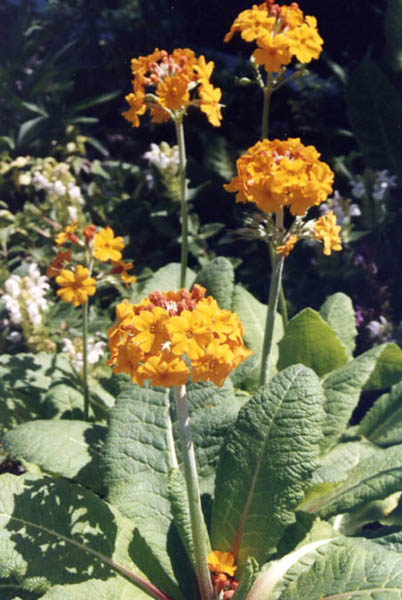
It forms large rosettes of oblong to oval leaves, rough and distinctly veined, of medium green, reaching up to 30 cm in length. The floral stems, upright and robust, rise to 40–60 cm and bear five to seven whorls of flowers stacked in the characteristic candelabra habit. The flowers are bright yellow-orange to pure orange, with a more pronounced eye, carried by pedicels and calyxes of brick-red to rust clearly visible between the whorls. The stems are slightly farinaceous, whitish, which accentuates the contrast with the warm tones of the bloom.
In its natural habitat, its flowering extends from June to July. In cultivation, it generally blooms in May-June.
It requires deep soil, rich in humus, constantly fresh to moist, in full sun or light partial shade. Perfectly suited to the banks of water features and moist woodland gardens, it readily self-seeds in favorable conditions and easily hybridizes with other candelabra species cultivated nearby.