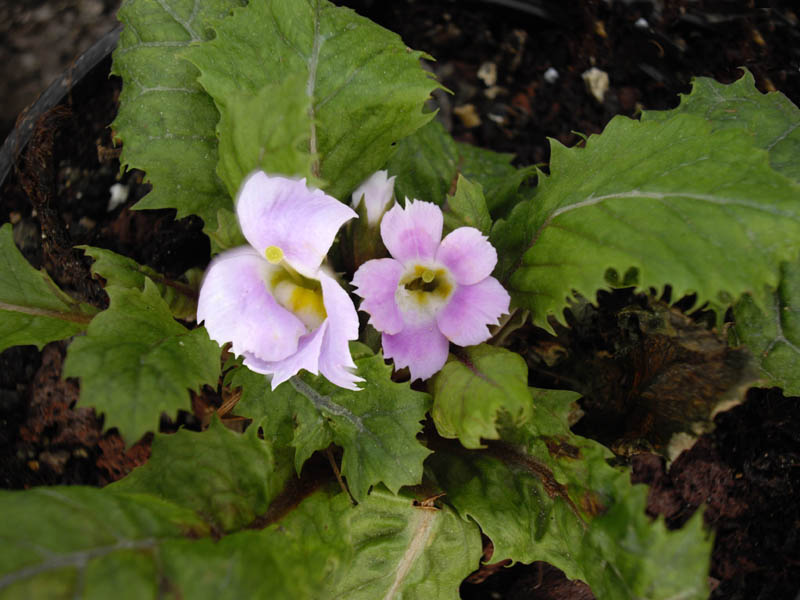
A perennial of the Primulaceae family, this primrose is native to Nepal and Sikkim, where it grows in the humid, shaded rocky areas of high-altitude forests, between approximately 3,000 and 4,000 meters. It belongs to the section Crystallophlomis, a group of Himalayan primroses with characteristic large foliage.
It forms rosettes of remarkably large leaves, oval to suborbicular, strongly blistered and crinkled, with irregularly toothed margins, a bright green and somewhat leathery texture. This ample and pleated foliage is the most immediately striking feature of the plant. The flowers, borne in sessile or very shortly stalked umbels, almost nestled in the leaves, are pale lilac-pink with a yellowish throat, with slightly notched petals.
In its natural habitat, its flowering extends from April to June depending on the altitude.
In cultivation, it requires a substrate rich in humus, fresh to moist, well-drained, in shade or partial shade. It is sensitive to drought and excessive summer heat. Its cultivation is demanding and is better suited to alpine gardens in a cool oceanic climate or cultivation under a cold frame.