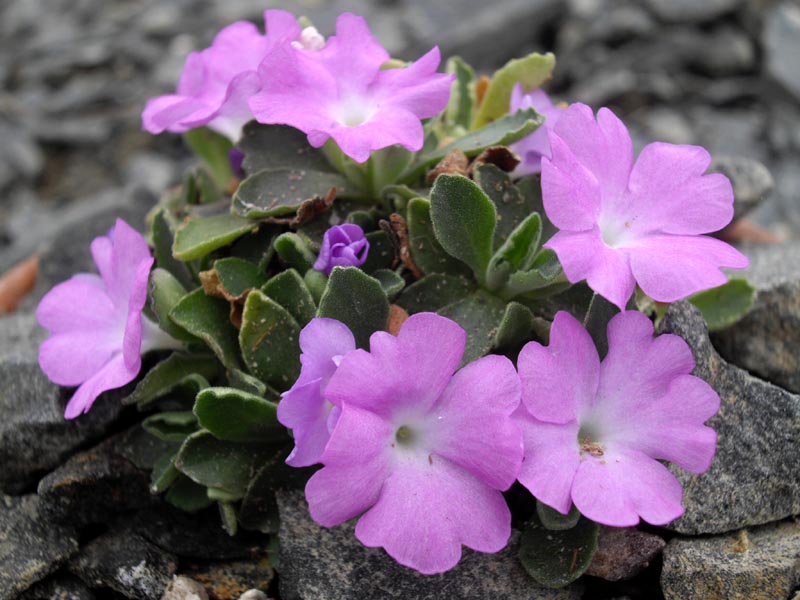
A perennial from the Primulaceae family, Primula allionii is a strict cliff-dwelling species from the Alpes-Maritimes and Liguria, where it colonizes vertical or overhanging limestone cliffs, in shaded crevices protected from direct rain, at altitudes of approximately 500 to 1,800 meters. The HNG12 cultivar is part of this lineage of a demanding and precious species, closely followed by alpine plant enthusiasts.
The tuft is compact and dense, formed of small oval to spatulate leaves, dark green and slightly grayish, with a finely glandular and sticky surface to the touch, a characteristic specific to the species. The growth remains very low, barely a few centimeters, giving it the appearance of a tight cushion naturally hugging the rock.
The flowers of HNG12 are a bright lilac-pink, quite vivid, with a well-defined white eye that centers and lightens each corolla. The petals are broad, slightly notched, and the flowers are borne in sufficient numbers to almost entirely cover the foliage at the peak of flowering. In its natural habitat, the species blooms from March to May depending on altitude; in cultivation under cold shelter, it generally occurs from February to April.
Cultivation requires protection against winter and spring rains, as stagnant moisture on the foliage is the main cause of failure. A well-drained mineral mix, bright exposure without harsh direct sunlight, and measured watering at the base are sufficient to keep the plant healthy. It is traditionally cultivated in a pot under an open shelter, or in a rock crevice sheltered by an overhang.