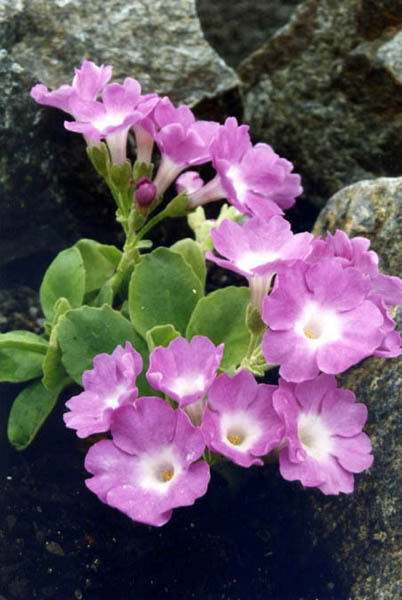
Perennial of the Primulaceae family, this cultivar of Primula allionii originates from the rock-dwelling species of the Alpes-Maritimes and Liguria, where the wild form colonizes shaded limestone cliffs and crevices protected from direct rain, between 500 and 1,800 meters. 'Beatrice Wooster' is one of the oldest selected cultivars and most frequently cited in the specialized literature of the Alpine Garden Society.
The foliage is distinctly different from that of the previous cultivar by its bright and vivid green color, without the glaucous gray observed on other forms of the species. The leaves are oval to spatulate, with a glandular surface, and form a relatively open rosette, less tight than some very compact cushions of the species.
The flowers are of a fairly intense magenta pink, with an enlarged and well-contrasted white eye, slightly tinged with yellow at the center, giving them a bright and vivid appearance. The petals are broad, scarcely or not at all notched, giving each corolla an almost entire outline and a certain amplitude. The flowering is generous, with the flowers borne on short peduncles that raise them above the foliage. In its natural habitat, the species blooms from March to May depending on altitude; in cultivation, 'Beatrice Wooster' generally blooms from February to April under cold shelter.
Like all representatives of the species, this cultivar requires effective protection against winter moisture on the foliage, a very well-drained substrate with a mineral dominance, and a bright exposure without excessive direct sunlight. Pot cultivation under an open canopy or in a well-sheltered rock crevice remains the safest method to preserve the plant in the long term.