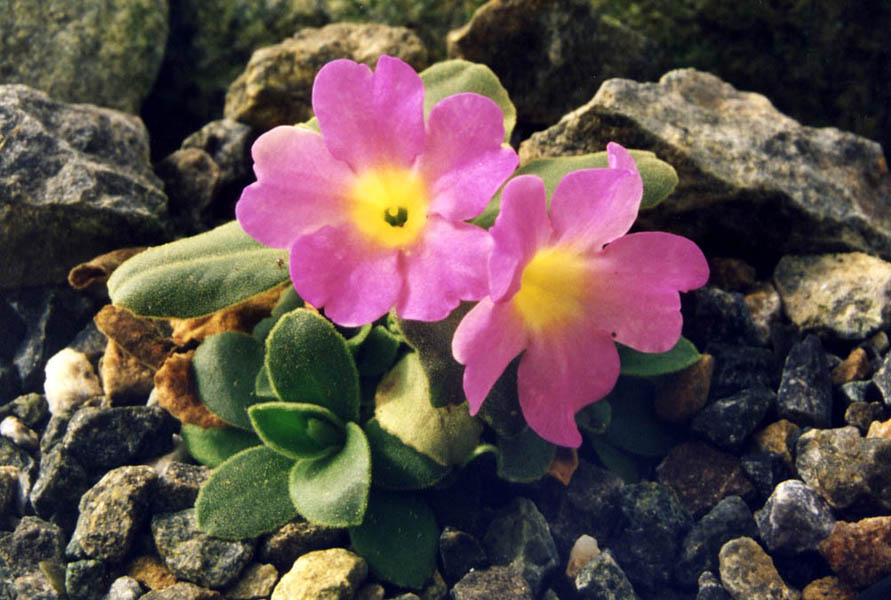
Primula allionii — Primulaceae. A perennial species endemic to the Franco-Italian Maritime Alps, where it grows in the crevices of shaded limestone rocks and moist rock faces, between approximately 500 and 2,000 meters.
The plant forms a low and dense rosette, scarcely exceeding 5 to 8 cm in height. The leaves, oval-spatulate, of a gray-green color, are covered with fine glandular hairs that give them a characteristic velvety texture to the touch. This sticky and glandular foliage is one of the most distinctive features of the species, allowing it to retain dust and small debris in its natural rocky habitat.
The flowers, borne almost sessile at the level of the foliage, have large pink to deep magenta-pink notched petals, with a well-defined bright yellow eye. This unidentified cultivar is distinguished by the abundance of its flowering and the richness of its color.
In its natural habitat, its flowering extends from March to May depending on the altitude. In cultivation under cold shelter, it can bloom as early as February.
Primula allionii is reputed to be delicate and is cultivated almost exclusively in pots or alpine troughs, protected from winter moisture on the foliage, in a very draining, slightly calcareous substrate. It is less afraid of cold than of excess water at the collar.