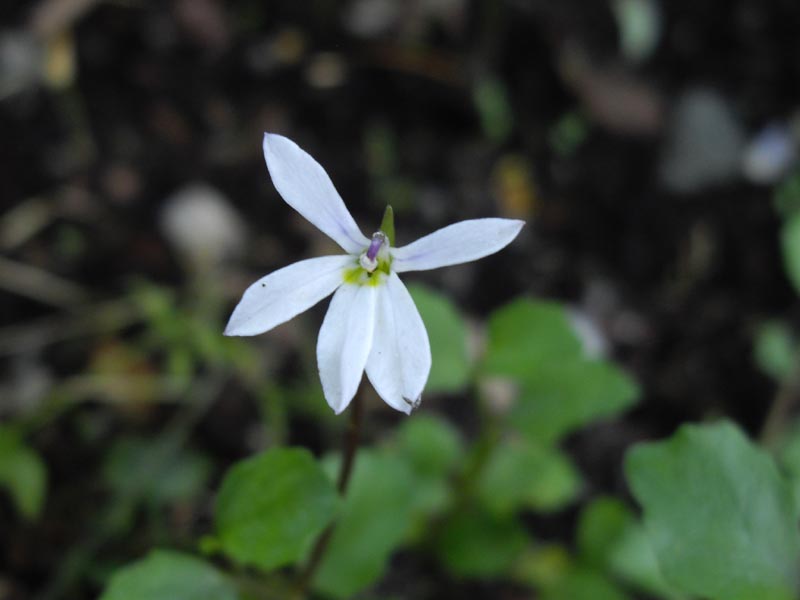
(Pratia angulata)
(Pratia angulata)
A perennial of the Campanulaceae family (subfamily Lobelioideae), Pratia angulata is native to New Zealand, where it colonizes moist meadows, stream banks, boggy areas, and open lawns with cool soil, from sea level to mountainous regions.
It forms a creeping and dense carpet, 2 to 5 cm high, by stolons rooting at the nodes. The leaves are small, rounded to oval, slightly crenate, with a shiny dark green, arranged regularly along the stems.
The flowers, borne individually on slender erect peduncles, exhibit the bilabiate structure characteristic of the subfamily: five narrow and elongated petals, white, sometimes veined with lilac, with a yellow-green center and a violet staminal column. This asymmetrical arrangement is one of the most distinctive features of the plant. In its natural habitat, flowering extends from spring to summer. In cultivation under temperate climates, it blooms from May to August.
It requires constantly cool to moist soil, in a sunny to partially shaded position. It is suitable for moist rock gardens, the edges of water features, and the interstices of pavings in cool situations. Its hardiness is moderate and requires attention in climates with harsh winters.