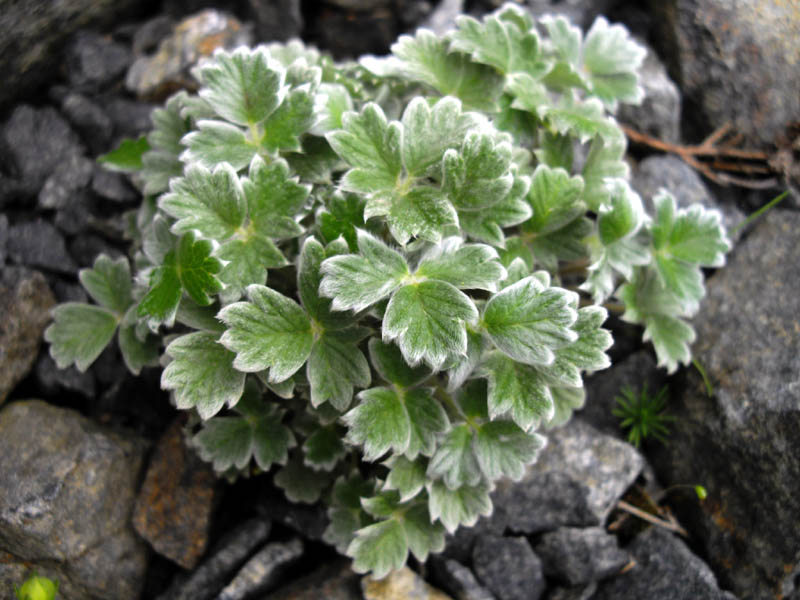
Perennial of the Rosaceae family, Potentilla pulvinaris is an endemic species of Turkey, described by Fenzl in 1842. It grows in high-altitude rocks and screes, between 2000 and 3650 meters, on poor and very well-drained substrates.
It forms a dense and compact cushion 5 to 10 cm in height. The leaves are palmatipinnate, with 3 to 5 obovate leaflets 4 to 10 mm, apically toothed, entirely covered with a silky gray pubescence that gives the plant a silvery and woolly appearance, striking even outside of flowering.
The bright yellow flowers measure 12 to 15 mm in diameter and are borne by 1 to 2 upright stems, barely above the foliage. In its natural habitat, flowering extends in summer.
In cultivation, it requires perfect drainage, poor soil, full sun exposure, and protection against stagnant winter moisture; cultivation in a cold alpine greenhouse is recommended in humid climates. Propagation is done by sowing in spring, division at the beginning of the season, or cuttings at the end of summer.