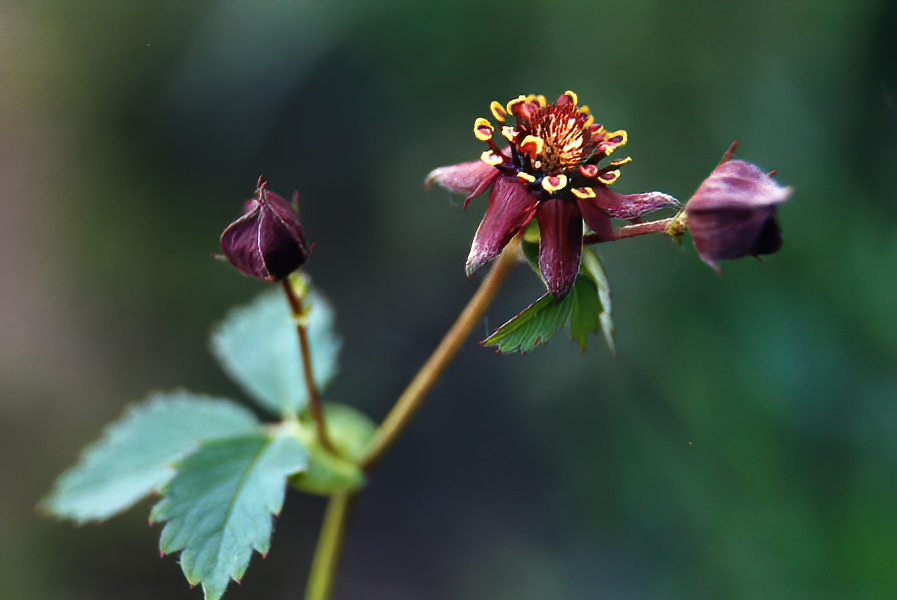
Perennial of the Rosaceae family, Potentilla palustris — also known as Comarum palustre, classification retained by some authors — is a circumboreal species, widespread throughout Northern and Central Europe, Asia, and North America. It inhabits bogs, marshes, ditch edges, and pond shores, in both plains and mountains.
It forms upright clumps with reddish stems, reaching 20 to 50 cm in height. The leaves are pinnate, with five or seven oval, toothed leaflets, glaucescent green on the upper side, paler underneath.
The flowers, borne in loose cymes, are a deep dark red to very deep purple, almost chocolate, with broad, spreading sepals that clearly exceed the small petals, and a center of yellow-orange stamens that sharply contrasts with the whole. This unusual color palette for a cinquefoil — no other in the genus blooms in these tones — is immediately recognizable. In its natural habitat, flowering extends from June to August.
In cultivation, it requires soil that is constantly moist to waterlogged, in full sun or partial shade, and is suitable for the edges of water bodies or bog gardens.