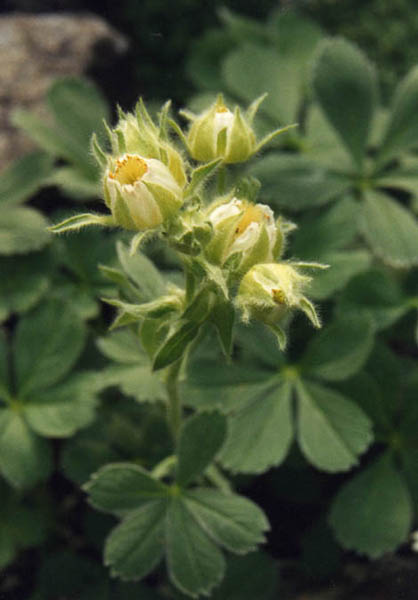
Perennial of the Rosaceae family, Potentilla nivalis is a species of the mountains of southwestern Europe, present in the Iberian Peninsula — Sierra Nevada, central system — and in the Pyrenees. It occupies rocky grasslands, stabilized screes, and high-altitude snow hollows, generally between 1,800 and 3,000 meters, on varied substrates.
It forms rather loose spreading tufts, 8 to 12 cm in height when in bloom. The leaves are palmate, with five broadly obovate, deeply toothed leaflets, ranging from medium green to dark green; the entire plant is covered with dense, silky hairiness, particularly developed on the flowering stems and sepals.
The flowers are small, pale yellow to yellowish-green, with five short petals largely surpassed by the hairy, starry sepals, which dominate and frame the flower to the point of almost completely masking it. This hairy and radiant calyx first captures the eye. In its natural environment, flowering extends from June to August depending on altitude and exposure.
In cultivation, it requires well-drained soil, in full sun. Its dense hairiness, adapted to the harsh conditions of high mountains, retains moisture in contact with the foliage and makes it susceptible to rot in case of prolonged winter rains. Protection against winter moisture is strongly recommended.