Perennial of the Rosaceae family, Potentilla nepalensis is native to the Himalayan foothills, from northern India to Nepal, where it grows on grassy and rocky slopes between approximately 1,500 and 3,000 meters, in areas with marked monsoons.
It forms a bushy clump with branched and spreading stems, reaching 30 to 45 cm in height when in flower. The leaves are palmate with five oval, toothed leaflets, of a medium green, slightly hairy, borne on long petioles; the basal leaves are noticeably larger than the cauline ones.
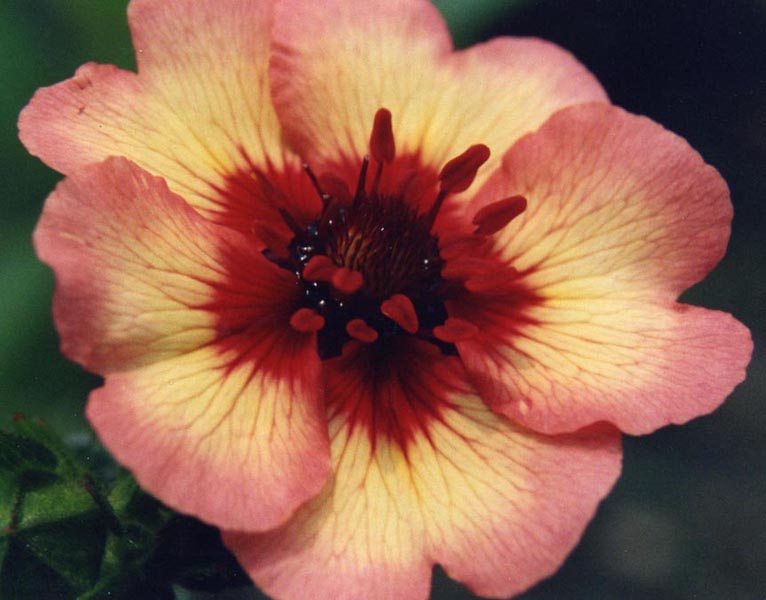
The flowers of this cultivar are large, with five slightly wavy rounded petals, of a strong cherry to raspberry pink, traversed by fine darker veins converging towards a very pronounced dark brown central eye. Plants grown from seed produce notable variation, from raspberry pink to creamy salmon, with different eye intensities — well illustrated by the photographs. In its natural habitat, flowering extends from June to August. In cultivation, it occurs from June to September if the stems are cut back after the first wave of flowers.
It requires well-drained soil, moderately rich, in full sun. It tolerates dry periods but becomes exhausted on overly poor and dry soils. The typical cultivar is propagated by division; seedlings give variable but often attractive results.