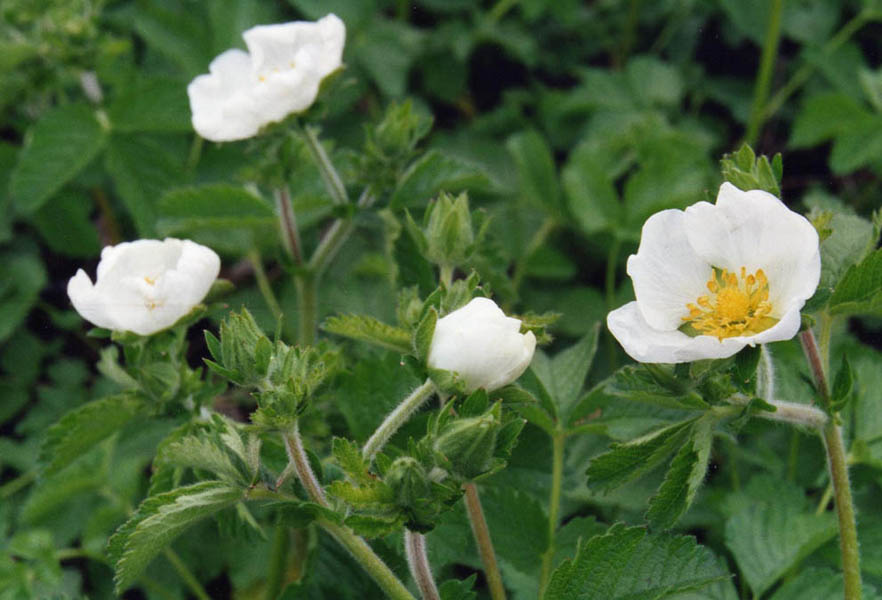
Perennial of the Rosaceae family, this cinquefoil is native to the Andes of South America, where it grows on grassy and rocky slopes at altitude. It is named after the French botanist and naturalist Joseph Dombey, who explored Chile and Peru at the end of the 18th century.
It forms vigorous and spreading clumps, reaching 20 to 40 cm in height when in bloom, with ascending and branched stems. The leaves are trifoliate, with oval leaflets that are strongly and irregularly toothed, medium green on both sides, borne on distinctly hairy to bristly petioles and stems, giving them a noticeably rough texture.
The flowers are white, with five broad and slightly wavy petals, with a bright yellow center of stamens. Carried in branched and loose cymes, they are produced abundantly, generously covering the plant at the time of flowering. In its natural habitat, its flowering probably extends from the austral summer. In cultivation under our climates, it generally blooms from May to July.
It requires well-drained soil, moderately rich, in full sun or light partial shade. Its vigor and the pure whiteness of its flowers make it a remarkable plant among the white-flowered cinquefoils cultivated in rock gardens or natural beds.