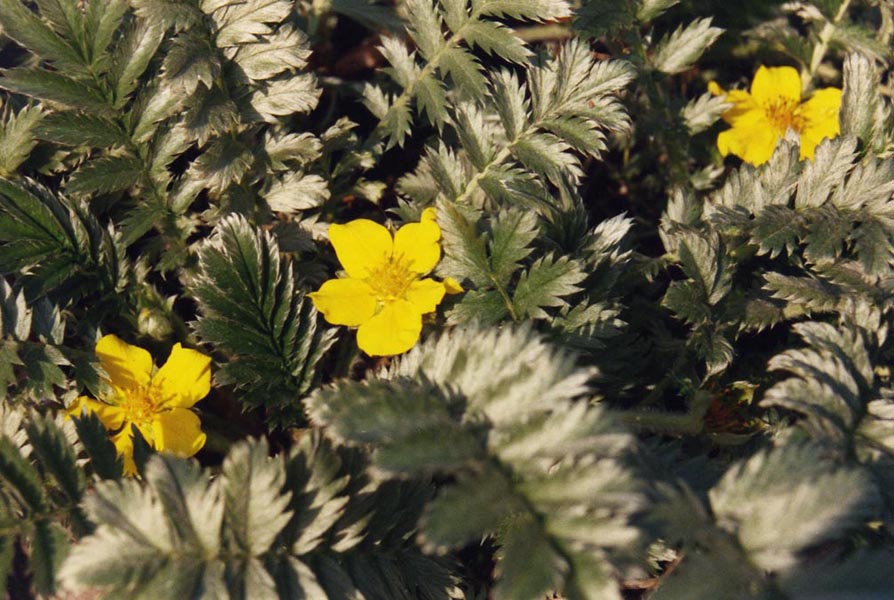
Perennial of the Rosaceae family, the silverweed is a circumpolar species, present in almost all of Europe, temperate Asia, and North America. It occupies disturbed grounds, roadsides, grazed meadows, shores, and sandy or slightly salty soils, from sea level to mountainous areas.
The plant develops in creeping mats, spreading by long stolons, and hardly exceeds 5 to 15 cm in height. The leaves are pinnate, composed of numerous oval leaflets with deeply toothed edges, covered on both sides with a silky tomentum that gives them a uniform, almost metallic silvery hue. It is this entirely silky foliage that earned the plant its common name of silverweed.
The flowers, solitary on long upright peduncles, have five bright yellow well-rounded petals, which contrast sharply with the silver of the foliage. In its natural habitat, its flowering extends from May to August.
The fleshy roots were once consumed during times of famine, and the plant has been used in folk medicine as an astringent. It is suitable for poor, well-drained soils in full sun, but its covering and stoloniferous nature requires control in cultivation.