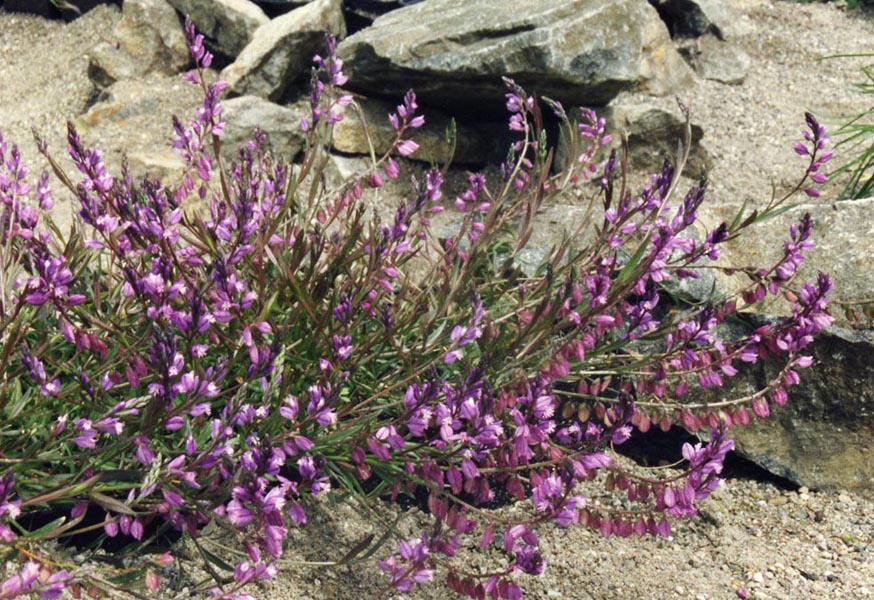
Perennial of the Polygalaceae family, widely spread in Europe, from the Iberian Peninsula to the Baltic countries and up to Western Siberia. It frequents sparse grasslands, heaths, calcareous or siliceous meadows, roadsides and sunny embankments, from sea level to mountain levels, exceeding 2,000 meters in the Alps.
It forms loose clumps of slender stems, erect to slightly reclining at the base, reaching 10 cm in height. The lower leaves are small and oval, the cauline leaves narrower and lanceolate — a characteristic that distinguishes it from Polygala amarella, whose basal leaves are notably wider. The plant is herbaceous, without woody characteristics at the base.
The flowers are gathered in upright terminal clusters, quite abundant. The color is variable — blue, violet, pink or white depending on the individuals — but the pink-violet to lilac-purple forms, like those visible here, are common. The two large petaloid wings frame a keel with a fringed apex, characteristic of the genus.
In its natural habitat, its flowering extends from May to August depending on altitude and latitude. In cultivation, it generally blooms from May to July.
It adapts to various soils, poor to moderately fertile, well-drained, in the sun or light partial shade. Its wild and discreet nature makes it a plant for naturalizing in dry lawns and rockeries with a spontaneous character, rather than a spectacular collection plant.