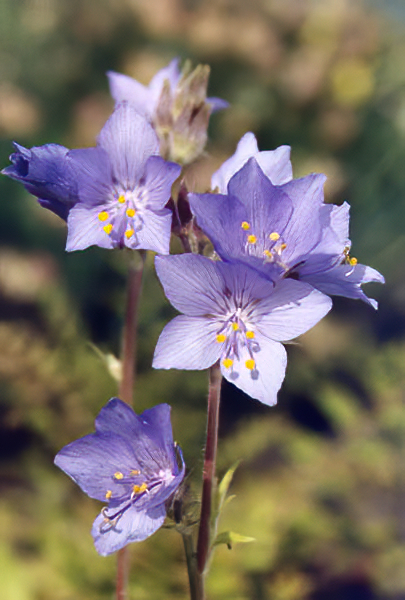
Perennial of the Polemoniaceae family, Polemonium pulcherrimum is a circumpolar species of the mountainous and subarctic regions of North America, Northern Europe, and Asia, where it occupies rocky slopes, stabilized screes, and open alpine meadows, generally between 1,500 and 3,500 meters in altitude.
It forms low and compact clumps, significantly more modest than Polemonium caeruleum, reaching 15 to 30 cm in height. The stems, often tinged with reddish-brown and slightly glandular, bear pinnately dissected foliage with tightly packed oval leaflets, of a bright green. This unpleasant smell when crushed, noted by several floras, is a distinctive feature of the genus at this scale.
The flowers, in a broadly open cup, are a fairly strong lavender-blue to blue-violet, with a distinctly paler, almost white center, which highlights the stamens with bright orange-yellow anthers. The slightly flared and rounded petals give the flower a particularly neat appearance, fully justifying the epithet pulcherrimum.
In its natural habitat, flowering extends from June to August depending on altitude. In cultivation, it generally occurs in May-June.
It requires well-drained soil, mineral or slightly humus-rich, in full sun, with good spring moisture. Perfectly suited to alpine rock gardens, it is more demanding than lowland species regarding winter drainage.