Perennial of the Polemoniaceae family, Polemonium pauciflorum is native to the mountains of the southwestern United States and northern Mexico, where it grows on rocky slopes and in open forests of pines and oaks, at altitudes between approximately 1,500 and 2,500 meters.
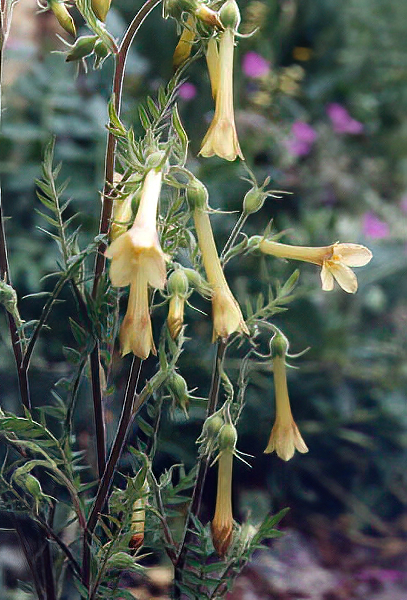
The plant forms rather loose upright clumps, reaching 40 to 60 cm, bearing stems often tinged with dark reddish-brown, glandular-sticky. The pinnately dissected foliage, with narrow and numerous leaflets, is finely cut and almost feathery in appearance.
What immediately distinguishes this species within the genus is the shape of its flowers — elongated in a narrow tube, hanging or slightly inclined, from pale yellow to tawny yellow, barely flared at the end, very different from the open cup characteristic of other Polemonium. This tubular morphology suggests an adaptation to pollination by long-tongued insects.
In its natural habitat, flowering extends from July to September. In cultivation, it shows similar behavior.
It requires well-drained, rather poor soil, in full sun or light partial shade, with good winter protection in areas with prolonged frost. Its hardiness remains limited under humid and cold European climates.