Perennial with woody base from the Polygonaceae family, found on the coasts of the Mediterranean, European Atlantic, Azores and Canaries, as well as on the shores of North Atlantic America. It colonizes maritime sands and gravels, strandlines and mobile dunes, in conditions of intense salinity, dryness and sunlight.
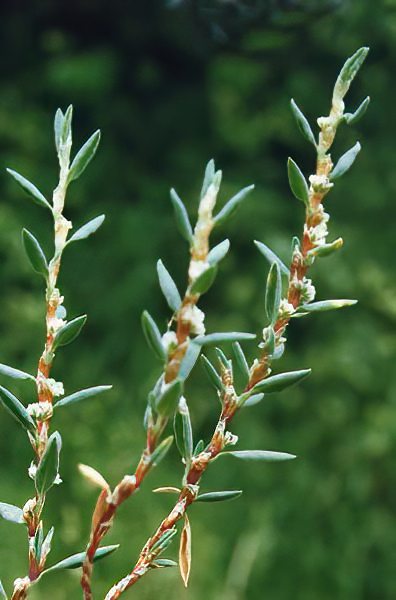
It forms creeping to ascending stems, branched from the base, 10 to 40 cm in length, woody in their lower part with age. The leaves are small, oblong to elliptical, thick and glaucous, with a characteristic bluish gray-green, indicative of a marked adaptation to xerophily and salt resistance. The ochreae, membranous sheaths encasing the nodes, are silvery to browning, clearly visible and distinctive of the genus.
The flowers are tiny, white-pink to pale pink, solitary or in small axillary groups, discreet, nestled in the leaf axils along the stems.
In its natural habitat, its flowering extends from June to September.
In cultivation, it requires a very well-drained, sandy or gravelly soil, a warm and sunny exposure, and tolerates summer drought well. It withstands salt and is suitable for coastal gardens. Its hardiness in a humid continental climate remains limited and should be verified according to local conditions.