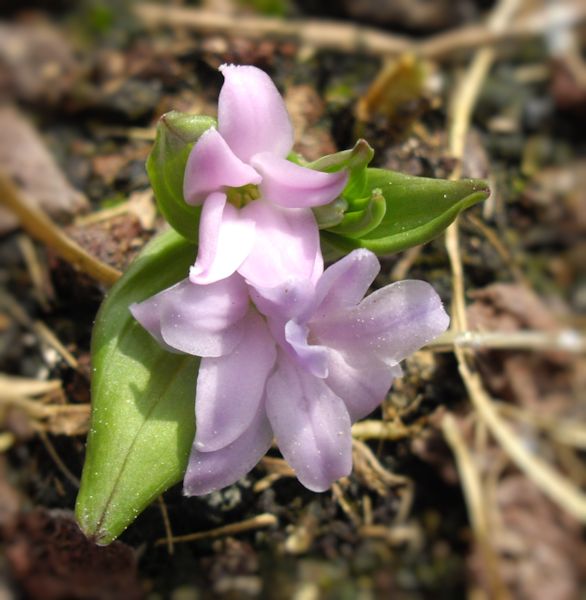
Dwarf perennial of the Polygonaceae family, native to the high mountains of the Himalayas, Tibet, and Sikkim, where it grows on alpine meadows, stabilized screes, and rocky soils at altitude, generally between 4,000 and 5,500 meters. It is among the plants that grow closest to the ground in extreme conditions of cold, wind, and prolonged snow cover.
It forms very low, almost acaulescent small clumps, barely exceeding 3 to 5 cm in height when in bloom. The leaves are oval, thick, medium green, borne on short petioles, and remain very close to the ground.
The flowers are relatively large compared to the rest of the plant, which is one of its most striking features. They are lilac pink to pale pink, with five tepals, sessile or almost sessile, emerging directly between the leaves in small, tight groups at ground level.
In its natural habitat, its flowering extends from July to August depending on the altitude.
In cultivation, it requires perfect drainage, a poor and mineral substrate, full sun exposure, and protection against stagnant moisture in winter. It is suitable for cultivation in an alpine house or in a very well-drained rock garden. This species remains rare in cultivation and represents a challenge for enthusiasts of demanding alpine plants.