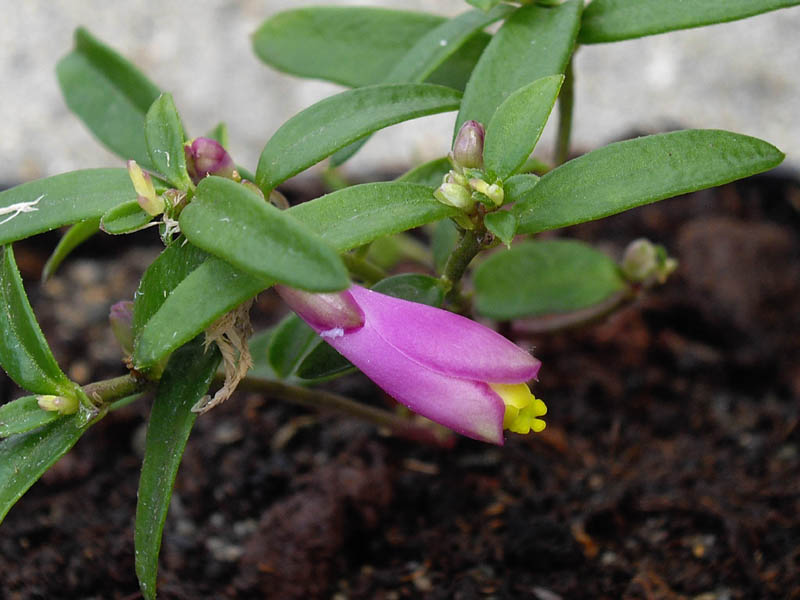
Evergreen subshrub of the Polygalaceae family, this selected cultivar of Polygala chamaebuxus is attributed to the Austrian nurseryman Loidl. It corresponds to a large-flowered form whose hue is noticeably more saturated and vivid than in the type species. Under the name 'Grandiflora', several marketed forms can be found, whose characteristics may slightly vary depending on their origin; the Loidl provenance is one of the best known in alpine plant circles.
The habit is that of the species, a creeping and spreading subshrub, with woody stems at the base, hardly exceeding 10 to 15 cm in height. The leaves are evergreen, leathery, oval-lanceolate, with a glossy dark green. What distinguishes this cultivar at first glance is the size of the flowers, notably larger than in the wild form, and especially the intensity of their color, with petaloid wings displaying a deep and bright rose-magenta, almost violet in certain lights, while the keel remains a bright and pure yellow. The contrast between the two colors is even more pronounced than in the type species.
In its natural habitat, Polygala chamaebuxus blooms from March to June depending on altitude. In cultivation, 'Grandiflora' generally blooms from April to May, sometimes with a few flowers earlier in a mild season.
It requires well-drained, humus-rich soil, in a sunny to partially shaded exposure, protected from stagnant winter moisture. It performs well in constructed rock gardens and in the crevices between stones, where it settles naturally.