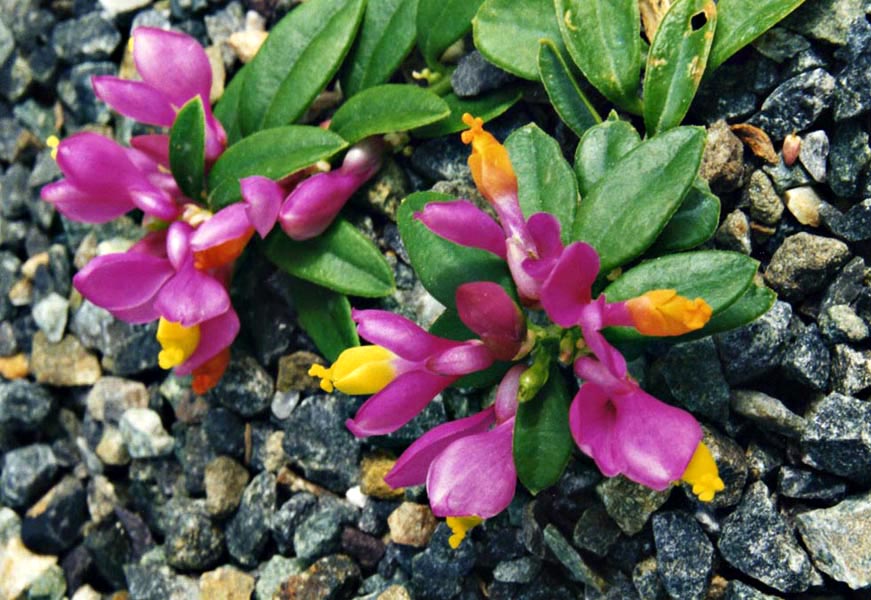
Evergreen subshrub of the Polygalaceae family, this polygala is widespread in the mountains of Central and Southern Europe, from the Alps to the Carpathians and the northern Apennines. It frequents the clear undergrowth of conifers or deciduous trees, shaded calcareous lawns, edges, and rocky slopes, generally between 500 and 2,000 meters in altitude, indifferently on limestone or silica.
It forms woody tufts at the base, spreading and creeping, reaching 8 to 15 cm in height. The leaves are evergreen, leathery, oval-lanceolate, with a shiny dark green, indeed evoking in miniature those of the boxwood — hence the name chamaebuxus, "little boxwood". It is one of the few European polygala with a frankly woody habit and evergreen foliage.
The flower is immediately recognizable by its striking color combination, unparalleled in the genus in Europe. The two large petaloid wings are a bright pink-purple to magenta, while the keel is bright yellow to yellow-orange, sometimes tinged with orange at maturity. This chromatic contrast stands out against the usual blues and purples of the genus.
In its natural habitat, its flowering extends from March to June depending on altitude and exposure. In cultivation, it can begin to bloom as early as February-March in mild regions.
It accommodates well-drained, humus-rich soil, in partial shade or filtered sunlight, and is more tolerant of shade than most other rock garden polygala. It is suitable for woodland gardens and shaded rock gardens, and is relatively easy to maintain in cultivation.