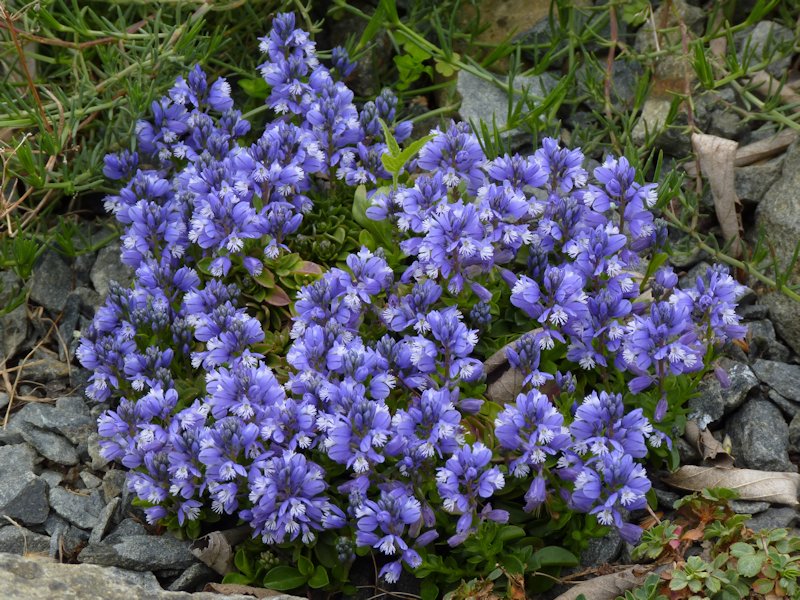
Perennial of the Polygalaceae family, this cultivar of Polygala calcarea is one of the most generous and most regularly available in specialized commerce. Its exact origin is not documented with certainty, but it has been well established in European rock garden collections for several decades. It shares with the type species its fundamental requirements, but is distinctly different in its cultivation behavior.
The habit is remarkably spreading and dense, forming large prostrate cushions that barely exceed 8 to 10 cm in height but can spread widely. The leaves are small, oval, a shiny green with slightly bronzed reflections on the young shoots — a hue clearly visible in the photographs, particularly noticeable in spring. The basal rosettes with leaves wider than the cauline ones are distinctly developed, in accordance with the character of the species.
The flowers are a soft and bright blue-lilac, noticeably paler and more washed out than in 'Bulley's Form', with the petaloid wings well open and the keel with very visible white fringes. They are produced in remarkable abundance, to the point of almost entirely masking the foliage at the height of anthesis, giving the plant the appearance of a uniformly bluish cushion.
In its natural habitat, Polygala calcarea blooms from April to June. In cultivation, 'Lillet' blooms in May, with a particularly generous and lasting flowering.
It requires well-drained soil, poor to moderately rich, in full light, with protection against excess winter moisture. It is more accommodating than many forms of the genus and is a reliable choice for the sunny rock garden or limestone trough.